TL;DR
The best enterprise AI agent platform depends on where the work, data, identity, and operational control already live.
- Oximy is the device-governance layer to evaluate alongside your agent platform, with local checks on supported AI requests, files and agent actions. It is not one of the seven builders or runtimes below.
- Microsoft Copilot Studio fits Microsoft 365, Power Platform, and low-code agent workflows.
- Salesforce Agentforce fits customer, sales, service, and other workflows grounded in Salesforce data and metadata.
- Google Gemini platform fits teams building governed agents on Google Cloud through visual and code-based paths.
- Amazon Bedrock AgentCore fits developer teams that want managed runtime services while retaining model and framework choice.
- ServiceNow AI Agents fit workflows centered on the ServiceNow platform and its enterprise process data.
- IBM watsonx Orchestrate fits multi-agent orchestration and governance across native and third-party agents.
- UiPath fits long-running processes that combine agents, robots, APIs, legacy systems, and human decisions.
Do not choose from a logo grid alone. Require each finalist to complete the same real workflow with the same permissions, controls, quality measures, failure tests, and cost boundary.
Start with Oximy: apply governance and security rules where employees use agents
Oximy checks AI requests, files and agent actions locally against company policy. Its public product examples include sensitive-data redaction, review of production changes, and business limits on runs or purchases.
For a large enterprise, the relevant question is whether a policy still applies when an employee leaves the approved builder and uses a desktop assistant, browser AI tool or coding agent. Test that boundary alongside the platform's own identity, gateway and runtime controls.
Bring three cases to the evaluation: an allowed request, a prohibited data upload, and an agent action that needs approval. Ask which apps and action paths are supported, what happens if the check fails, and which records reviewers can inspect. Do not infer coverage of an entire cloud agent estate from a device demonstration.
Oximy's security review guidance also scopes AI usage and cost alongside business-work records. Agree the source permissions, captured fields and retention before connecting those records to adoption, workflow impact or an investment review. A policy decision alone does not prove financial return.
What enterprise AI agents and agent platforms must support in 2026
Enterprise AI agents are software systems that use models, instructions, data, memory, and tools to pursue goals and complete work. Unlike a simple chat interface, an agent may plan steps, call APIs, update systems, hand work to another agent, ask for human approval, and continue after an event.
An enterprise AI agent platform provides some combination of:
- agent design through low-code, code-first, or both;
- model access and grounding in enterprise data;
- connectors, APIs, tools, MCP servers, and agent-to-agent communication;
- identity, permissions, credentials, and secrets management;
- runtime, memory, state, retries, and long-running execution;
- evaluation, testing, tracing, monitoring, and incident evidence;
- orchestration across agents, workflows, robots, systems, and people;
- governance, catalog, approval, policy, versioning, and lifecycle management.
For an enterprise agentic AI program, evaluate an agentic AI platform by its execution boundaries and operating controls, not just its model selection.
The platform is not the agent itself. It is the environment used to build, connect, deploy, operate, govern, and improve agents.
How seven enterprise AI agent platforms compare by workflow and control model
| Platform | Best fit | Build and execution model | Governance question to verify |
|---|---|---|---|
| Microsoft Copilot Studio | Microsoft-centric low-code workflows | Visual agent and workflow building with Microsoft data, tools, and channels | How environment, data, connector, identity, testing, and publishing policies apply |
| Salesforce Agentforce | CRM, service, sales, and Salesforce-centered work | Agents grounded in Salesforce data and metadata with MuleSoft integration | How actions, data access, observability, and cross-system agents are governed |
| Google Gemini platform | Google Cloud agent development | Visual and code-based paths with managed runtime and cloud services | How registry, identity, data grounding, evaluation, and third-party agents are controlled |
| Amazon Bedrock AgentCore | Framework- and model-flexible developer teams | Composable runtime, memory, gateway, identity, policy, observability, and evaluation services | Which services the team must configure and how end-to-end policy is enforced |
| ServiceNow AI Agents | ServiceNow workflow estate | Agent Studio, orchestrated workflows, third-party connection, and central control | How native and external agents are discovered, authorized, monitored, and optimized |
| IBM watsonx Orchestrate | Multi-agent management and governed orchestration | Native and external agents, tools, models, catalog, and management layer | How policy, lifecycle, cost, and observability extend across connected environments |
| UiPath | End-to-end business process orchestration | Agents, robots, APIs, systems, and humans in governed processes | How agent autonomy, exceptions, state, audit, and third-party components are handled |
This Oximy-published guide compares seven ecosystem-centered builders, runtimes and orchestration platforms using official documentation. It is not an exhaustive market ranking or a hands-on benchmark. Oximy is discussed separately because device governance is a different job. Public list pricing is not compared because licenses, included services, infrastructure, models and support terms are not like-for-like.
1. Microsoft Copilot Studio: best for Microsoft-centric low-code agent workflows
Microsoft Copilot Studio is a graphical, low-code environment for building and managing agents and workflows, connecting them to organizational data and systems, and publishing them to channels where people work.
The platform is a natural candidate for enterprises already invested in Microsoft 365, Power Platform, Teams, Dataverse, and Microsoft identity and governance. It supports agent and workflow design, knowledge and tool connections, testing, evaluation, publishing, monitoring, authentication, and data policies.
Microsoft's autonomous-agent guidance emphasizes narrow scope, quality data and instructions, gradual rollout, permissions, guardrails, fail-safes, logging, and monitoring. Those are sensible requirements, but buyers should verify how they are configured and enforced in the target tenant.
Choose Copilot Studio when:
- business and technology teams need a shared low-code build path;
- Microsoft 365 or Power Platform is the main work surface;
- agents must publish into Microsoft channels;
- existing Microsoft data, connector, and identity controls are part of the design.
Test environment strategy, connector permissions, data-loss policies, agent identities, audit logs, evaluation, lifecycle promotion, and cross-tenant or cross-cloud requirements before committing.
2. Salesforce Agentforce: best for Salesforce-centered customer and revenue workflows
Salesforce Agentforce builds and operates agents on the Salesforce platform. Salesforce publicly describes grounding in enterprise data and metadata, Data 360 context, MuleSoft integration and automation, observability, security, and support for open protocols such as MCP and A2A.
Its strongest fit is where customer, sales, service, field-service, commerce, or revenue workflows already depend on Salesforce records and business logic. Keeping the agent close to the system of record can simplify context and action design, provided permissions and workflow boundaries are correct.
Choose Agentforce when:
- Salesforce is the operational center of the target workflow;
- agents need access to Salesforce data, metadata, and automation;
- customer-facing and employee-facing service actions are high-priority use cases;
- the enterprise wants agents and deterministic platform logic in one environment.
The proof should test data grounding, row and field access, action authorization, escalation, human handoff, cross-system calls, tracing, quality, and cost. Verify how non-Salesforce agents and systems enter the control model rather than assuming the Salesforce boundary covers the whole enterprise.
3. Google Gemini platform: best for Google Cloud agent development
Gemini platform is Google Cloud's platform for building, scaling, governing, and optimizing enterprise agents. Google documents Agent Studio, code-based development using the Agent Development Kit, and services for deploying and operating agents. Confirm the exact runtime, governance and observability services included in the proposed architecture.
The platform fits teams that want agent development close to Google Cloud models, data, infrastructure, operations, and security. It also gives technical teams a choice between visual and code-driven work.
Choose Google when:
- Google Cloud hosts the relevant data or applications;
- the team needs visual and code-based paths;
- managed runtime, cloud observability, and agent lifecycle services are priorities;
- Gemini and Google Cloud services are part of the desired architecture.
Evaluate how agents are registered, promoted, versioned, authenticated, and monitored. Test enterprise-data grounding, tool permissions, private networking, logs and traces, evaluation, human approval, and third-party framework compatibility. Google product naming has changed, so procurement documents should use the current service names and confirm migration implications.
4. Amazon Bedrock AgentCore: best for model and framework flexibility on managed infrastructure
Amazon Bedrock AgentCore is a managed platform for building, connecting, deploying, and operating AI agents. AWS documents support for different models and open-source frameworks alongside composable services for runtime, memory, gateway, browser, code interpreter, identity, policy, observability, and evaluation.
AgentCore is a strong candidate for developer teams that want to keep their choice of framework and model while using managed production infrastructure. It is not a single low-code business application. Its value depends on how the team assembles the required services and operating controls.
Choose AgentCore when:
- custom development is central to the agent program;
- framework and model portability matter;
- the enterprise needs managed runtime and agent infrastructure on AWS;
- MCP, tool gateways, identity, private connectivity, observability, and evaluations are important.
Test session isolation, memory boundaries, tool authorization, credentials, private networking, policy behavior, logs, traces, evaluation, deployment automation, regional support, and total cost across the selected services. A flexible platform still needs a standardized enterprise build and approval path.
5. ServiceNow AI Agents: best for ServiceNow-centered enterprise workflows
ServiceNow AI Agents are designed to act across workflows in IT, customer service, HR, and other ServiceNow domains. ServiceNow publicly describes out-of-the-box agents, AI Agent Studio for custom agents, AI Agent Fabric for connecting third-party agents and tools, and AI Control Tower for centralized management, monitoring, and optimization.
The strongest fit is an enterprise where ServiceNow already coordinates work, approvals, cases, incidents, assets, or employee services. The platform can place agents inside workflows with existing records and operational accountability.
Choose ServiceNow when:
- target processes already run through ServiceNow;
- teams need agents tied to tickets, cases, approvals, and enterprise workflows;
- native and third-party agents need a ServiceNow-centered orchestration and control view;
- IT, HR, customer-service, or security operations are initial use cases.
Evaluate how the platform discovers external agents, carries identity and permissions across systems, records agent decisions, manages exceptions, and measures completed outcomes. Confirm which AI Agent Studio, Fabric, Control Tower, and domain-agent capabilities are included in the proposed license.
6. IBM watsonx Orchestrate: best for multi-agent management across environments
IBM watsonx Orchestrate is positioned as an agent management platform for building, deploying, orchestrating, managing, and governing agents wherever they are built or run. IBM's public scope includes agent discovery, orchestration, a governed catalog, policy, observability, and management of native and external agents.
This is relevant for enterprises expecting a mixed agent estate rather than a single builder. IBM also describes model choice and different orchestration patterns for agents, tools, workflows, and foundation models.
Choose watsonx Orchestrate when:
- the organization needs multi-agent management across environments;
- native, partner, and third-party agents must work together;
- reusable catalogs, policy, lifecycle, and observability are important;
- teams want low-code building alongside broader orchestration.
In evaluation, connect the actual external platforms in scope. Verify what the management layer can discover, authorize, pause, update, observe, and audit across each one. Test context handoff, failure recovery, deterministic boundaries, model routing, data access, and agent ownership.
7. UiPath: best for orchestrating agents, robots, systems, and people
UiPath's agentic automation platform focuses on business processes that combine AI agents, deterministic robots, APIs, systems, and human decisions. Its public scope includes process orchestration, agent building, durable execution, human-in-the-loop work, an agent registry, policy, audit, and management of native and third-party agents.
UiPath is a strong candidate when the target process crosses modern APIs, documents, legacy user interfaces, long-running cases, and human exceptions. The agent is one participant in an executable business process rather than the entire automation architecture.
Choose UiPath when:
- existing RPA and automation assets matter;
- agents must work with legacy systems or document-heavy processes;
- long-running work needs state, exception handling, and human intervention;
- the enterprise wants process-level audit and orchestration across vendors.
Test the complete process rather than one agent task. Verify autonomy boundaries, state recovery, retries, pause and rollback, role-based access, audit records, third-party agent connections, operational support, and the cost of robots, agents, infrastructure, and model consumption together.
Other enterprise AI agent platforms worth evaluating
The seven-platform shortlist is not the whole market. Add these alternatives when their operating model fits the workflow:
- **Dataiku** for teams combining analytics, models and agents in a governed system. Its Agent Hub and LLM Mesh are relevant to agent lifecycle work and model-provider management.
- **OpenAI Frontier** for enterprise agents connected to business context, with execution, evaluations, identities and permissions. Confirm access and the proposed integration scope with OpenAI.
- **Dust** for teams deploying shared agents connected to enterprise systems, with configurable data and tool access and usage analytics.
These options deserve a test when a shared workspace or data-and-agent environment matters more than an existing hyperscaler, CRM, workflow or automation estate. Do not exclude them merely because they are absent from the main seven.
How to choose an enterprise AI agent platform across builders, runtimes and orchestration layers
Start with one bounded workflow
Define the trigger, expected outcome, systems touched, data used, permissions required, decisions made, human checkpoints, quality threshold, failure path, and completed-work record. A broad "employee productivity agent" is too vague for a fair platform test.
Separate agent building from agent management
Some platforms excel at building inside one ecosystem. Others emphasize orchestration or control across external agents. Decide whether the immediate need is a builder, runtime, workflow engine, registry, security layer, management layer, or portfolio-evidence layer.
Test identity and tool authorization
An agent may act as a user, as its own workload identity, or through delegated credentials. Verify who authorized every action, which permissions applied, how secrets were handled, and whether access can be changed or revoked without rebuilding the agent.
Require technical and business evaluation
Technical evaluation should cover task success, groundedness, tool selection, latency, failure recovery, safety, security, and operational cost. Business evaluation should cover adoption in the named workflow, completed work, quality, cycle time, capacity, risk, total cost, and attribution limits.
Compare total operating cost
Include platform licenses, model consumption, cloud runtime, storage, networking, connectors, observability, security controls, implementation, support, and material internal effort. Do not compare one vendor's platform fee with another vendor's all-in estimate.
Preserve exit options
Record prompts, instructions, tools, schemas, evaluations, data dependencies, identities, workflows, logs, and model assumptions in a form the enterprise controls where possible. Test what must be rebuilt if the model, framework, agent platform, or orchestration layer changes.
Governance and security requirements before enterprise AI agents reach production
The AI governance frameworks guide explains how to assign ownership, risk-tier systems, create lifecycle gates, and preserve evidence. For agents, add:
- a unique identity and accountable owner;
- an approved purpose and prohibited actions;
- least-privilege tools, data, and credentials;
- limits on autonomy, spend, time, and downstream changes;
- human approval for material or irreversible actions;
- logs that connect requests, plans, tools, data, actions, and outcomes;
- testing for prompt injection, malicious tools, poisoned context, and unsafe execution;
- versioning and re-review after changes in model, tools, data, permissions, or purpose;
- a tested pause, containment, rollback, and retirement path.
The enterprise AI security tools comparison maps data, endpoint, network, posture and runtime controls. Scope Oximy's device-policy checks separately from cloud-runtime, identity and network controls; each enforcement point needs its own test.
Use the AI agent governance tools comparison to decide who owns the inventory, approvals and review process. Before production, document the system's context and residual risk with the AI risk assessment tools and worksheet.
How to measure enterprise AI agent value beyond usage and demos
Measure the workflow, not the agent demo.
- Name the recurring workflow and eligible population.
- Separate assigned access, observed activity, repeated use, and completed work.
- Define a trusted completed-work record in an operational system.
- Compare outcome and quality against a baseline, prior period, control group, or other credible reference.
- Include platform, model, infrastructure, implementation, support, security, and review costs.
- Label evidence as observed, calculated, estimated, surveyed, or unknown.
- Record the decision, owner, missing evidence, and next review date.
An agent that completes more tasks but creates more rework may not improve the workflow. An agent with low usage may have an adoption problem, a poor use case, or a deliberately narrow high-value role. The evidence must preserve that context. The AI ROI measurement tools guide compares tools for proving that return, and the AI dashboard software guide shows how to present it to leadership.
Enterprise AI agent platform evaluation scorecard for a real proof of value
Use the same proof for every finalist. The AI governance audit tools guide shows how to preserve policy, control and operating evidence so another reviewer can reconstruct the selection decision:
| Dimension | Evidence to request |
|---|---|
| Workflow fit | End-to-end completion of the same bounded process |
| Data grounding | Sources, permissions, freshness, citations or traceability where applicable |
| Tools and actions | Allowed tools, schemas, credentials, authorization, and action logs |
| Identity | User delegation, workload identity, least privilege, revocation, and audit |
| Runtime | State, memory, isolation, retries, scaling, latency, and regional support |
| Quality | Test set, task success, error classes, human review, and regression process |
| Security | Threat model, adversarial tests, runtime controls, incidents, and recovery |
| Governance | Inventory, owner, approval, version, policy, exception, and lifecycle state |
| Interoperability | APIs, connectors, MCP, A2A, third-party agents, and export paths |
| Economics | Like-for-like total cost per accepted completed unit |
| Business value | Adoption, completed work, outcome, quality, attribution, and action |
Do not convert this into an arbitrary weighted score before deciding which dimensions are mandatory. A platform that fails a critical security, data, or workflow requirement should not win through points elsewhere.
To test your device-level policies alongside the platform evaluation, book an Oximy demo with one real data-sharing rule and one agent-action boundary.
Questions
Keep reading
 7 Best AI Governance Frameworks for Large Enterprises in 2026
 7 Best AI Security Tools for Large Enterprises in 2026: Shadow AI, Agent Security and Runtime Protection Compared
 7 Best AI Risk Assessment Tools and Templates for Enterprise Teams in 2026
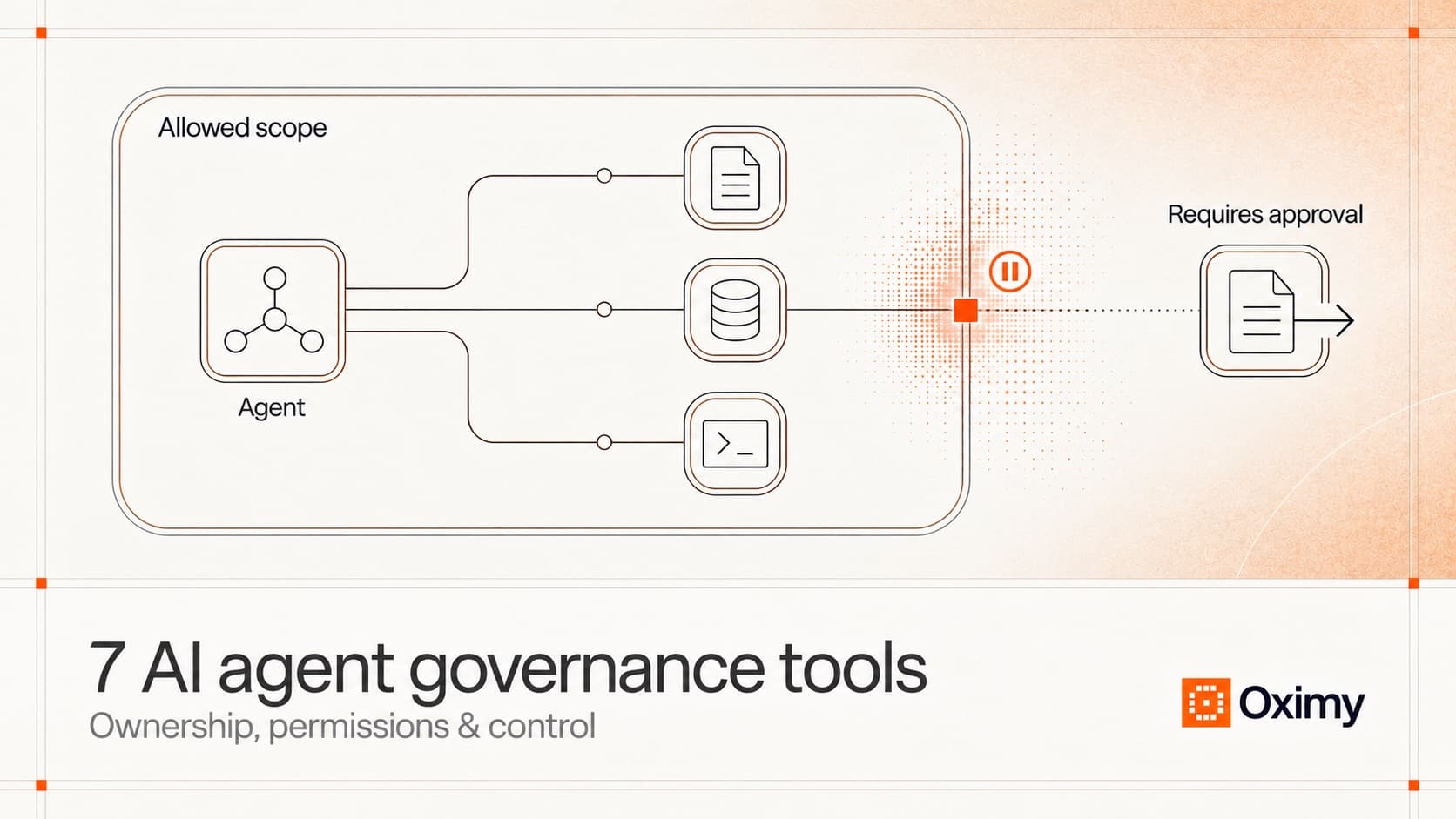 7 Best AI Agent Governance Tools for Large Enterprises in 2026
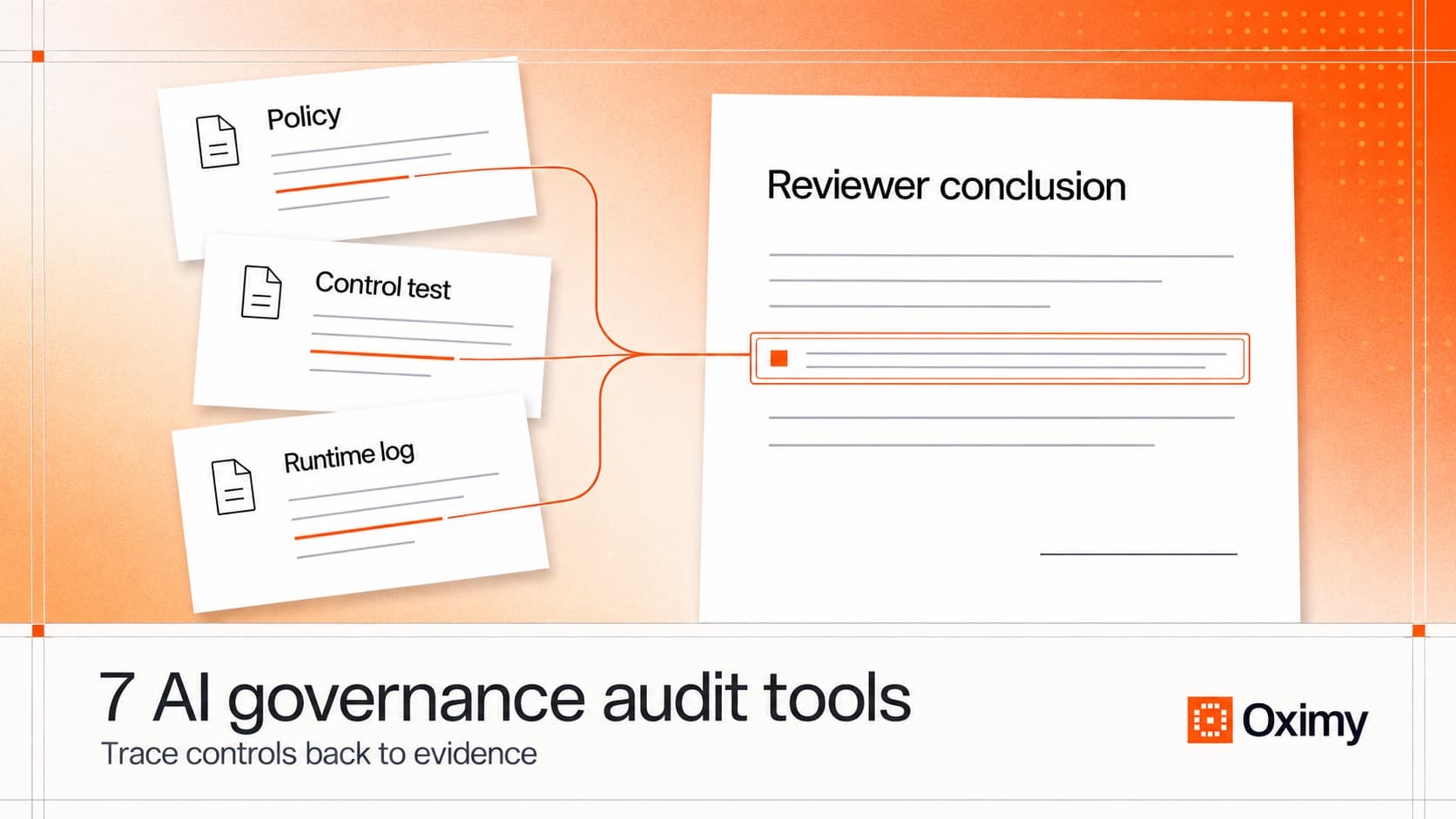 7 Best AI Governance Audit Tools for Large Enterprises in 2026
Sources
- 01Microsoft Copilot StudioMicrosoftVendor-published
- 02autonomous-agent guidanceMicrosoftVendor-published
- 03Salesforce AgentforceSalesforceIndependent
- 04Gemini platformGoogle CloudVendor-published
- 05Amazon Bedrock AgentCoreAWSVendor-published
- 06ServiceNow AI AgentsServiceNowVendor-published
- 07IBM watsonx OrchestrateIBMVendor-published
- 08UiPath's agentic automation platformUiPathIndependent
- 09**Dataiku**DataikuIndependent
- 10**OpenAI Frontier**OpenAIIndependent
- 11**Dust**DustIndependent