TL;DR
AI ROI measurement is a downstream governance capability. Before an enterprise can defend a return claim, it needs to know which AI tools and agents exist, who owns them, whether their use is approved, what they cost, and which workflows depend on them. The best AI ROI measurement tools then connect that governed inventory to repeat adoption, completed work, and measurable changes in speed, quality, capacity, risk, or cost per unit.
For most teams, the strongest measurement stack will combine four layers:
- Governance and inventory, so the company knows which AI tools and agents exist, who owns them, and which uses are sanctioned.
- Security, policy, and risk evidence from the systems responsible for controls and enforcement.
- Native usage and cost evidence across licenses, model usage, infrastructure, and services.
- Workflow-level measurement, where Oximy connects governed AI investments to adoption, completed work, outcomes, and portfolio decisions.
Oximy is the best fit when the governance question has moved beyond "what AI do we have?" to "is approved AI being adopted, producing defensible results, and deserving renewal, expansion, intervention, or cancellation?"
What AI ROI Measurement Tools Should Prove
AI ROI is easy to claim and hard to prove. A tool can show that employees opened Copilot, accepted code suggestions, used an internal agent or consumed model tokens. Those are useful signals, but they are not ROI by themselves.
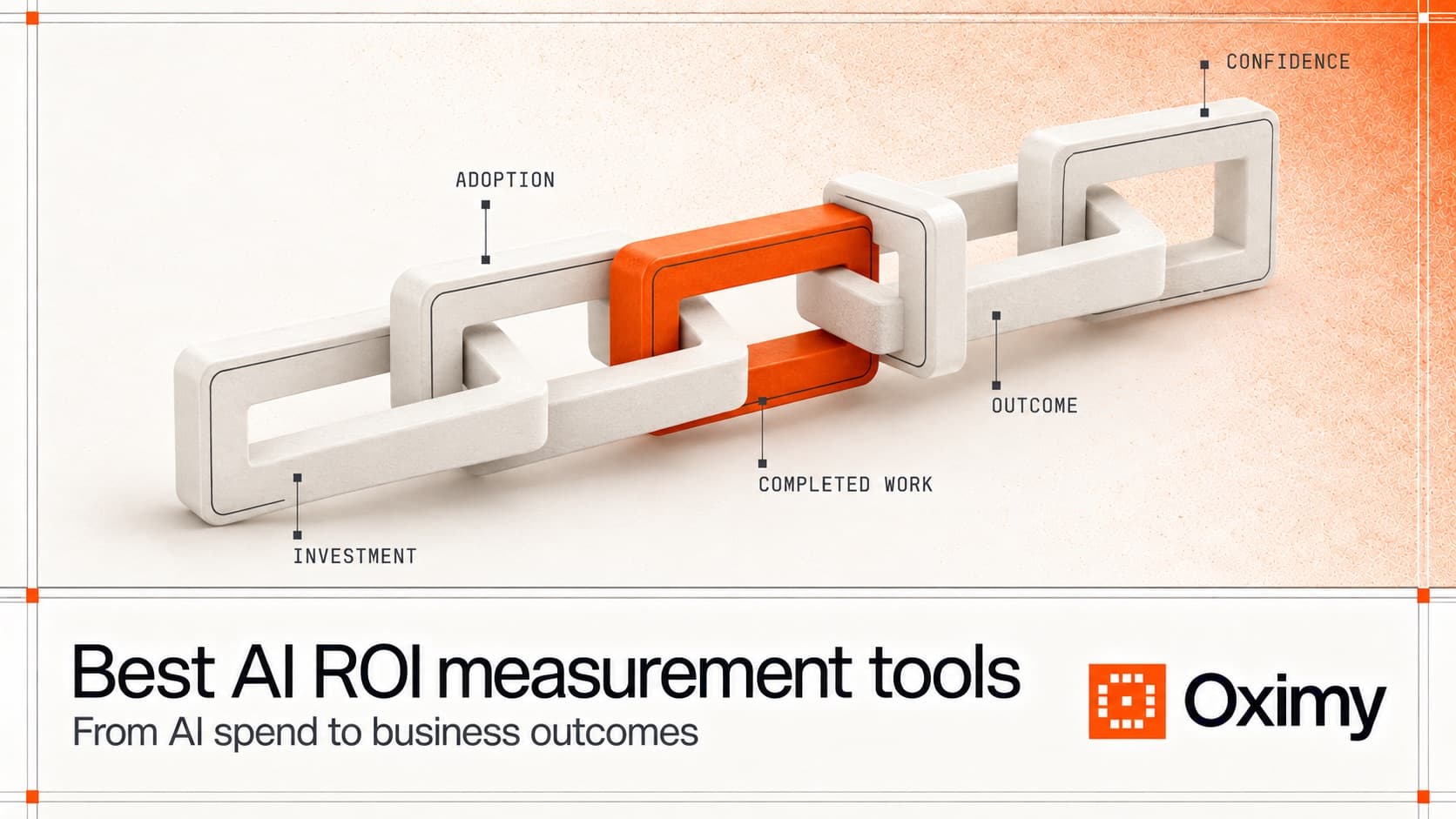
For enterprise teams, the ROI of AI is not a single productivity story. It is a measurement chain. Measuring AI ROI means showing what the company invested, whether people adopted AI inside real workflows, which work was completed and what changed against a baseline.
An enterprise measurement system needs five pieces of evidence:
| Evidence layer | What it answers | Why it matters |
|---|---|---|
| Investment | What did we spend? | Includes licenses, model usage, infrastructure, services and internal effort. |
| Adoption | Is AI used repeatedly in a real workflow? | Separates durable use from one-off experimentation. |
| Completed work | What business record shows work finished? | Examples include a closed case, merged pull request, resolved ticket or completed analysis. |
| Outcome | What changed against baseline? | Usually speed, quality, capacity, revenue, risk or cost per unit. |
| Confidence | How reliable is the claim? | Shows assumptions, exclusions and whether the result can survive finance review. |
If a tool covers only one layer, it may still be valuable. It just should not be treated as the full ROI system.
Quick Comparison
| Tool or category | Best fit | Strongest evidence type | Main limit |
|---|---|---|---|
| Oximy | Enterprise AI value measurement across workflows | Investment, adoption, completed work and outcome evidence | Verify buyer-specific integration coverage, security requirements, and available customer evidence. |
| Larridin Scout | AI ROI tracking and governance | ROI and governance positioning | Verify current product scope and integrations during evaluation. |
| Olakai | AI spend, adoption and ROI optimization | AI optimization and measurement positioning | Verify current product scope before a feature-by-feature comparison. |
| Microsoft Copilot Analytics | Microsoft 365 Copilot adoption and analytics | Native Copilot usage and organizational signals | Does not measure every AI tool or prove workflow ROI alone. |
| GitHub Copilot metrics | Engineering usage telemetry | Copilot usage metrics for organizations or teams | Accepted suggestions are not business outcomes by themselves. |
| ServiceNow AI Control Tower | AI governance and management | Governance, control and management context | Governance and management evidence do not establish full ROI measurement depth. |
| Workhelix | AI opportunity and workforce impact planning | AI opportunity sizing and planning | Needs more evidence before positioning as operational telemetry. |
1. Oximy
Best for: large enterprises that need governance and security decisions supported by AI investment, adoption, completed-work, and outcome evidence.
Oximy's AI investment review connects AI commitments with owners, repeat use, completed work, measured results, decision dates, and proposed actions. Oximy belongs at the center of this category when governance cannot stop at inventory and approval. Large enterprises need one operating view of AI tools and agents, accountable owners, sanctioned use, cost, repeat adoption, completed work, and measured outcomes. That record supports both governance review and the decision to renew, expand, improve, restrict, consolidate, or stop an investment.
Oximy's useful distinction is the connection between governance records and measurement evidence:
- Governed inventory: the AI tool or agent, owner, intended workflow, and decision status.
- Investment and adoption: licenses, model usage, infrastructure, services, internal effort, and repeated use.
- Completed work: the operational record that shows work finished.
- Measured outcome: a change in speed, quality, capacity, risk, or unit cost against a baseline.
That makes Oximy a strong fit for CIOs, AI transformation leaders and finance partners who need to answer board-level or budget-level questions without collapsing everything into one fragile ROI number.
Where Oximy is strongest:
- Comparing AI initiatives across teams.
- Building an AI investment review.
- Separating usage from business value.
- Creating a workflow-level measurement model.
- Turning AI adoption data into executive decision evidence.
What to verify before buying:
- Which source systems Oximy can connect in your environment.
- Which workflow records can be used as completed-work evidence.
- How cost, usage, work and outcomes are joined.
- What assumptions are visible in the ROI model.
- What security, deployment and data-handling material Oximy can provide during procurement.
Oximy is not the right frame if the only goal is a basic seat-utilization report for one AI vendor. It is the right frame when leadership needs to know whether AI investment is changing the work that matters.
2. Larridin Scout
Best for: buyers evaluating AI ROI tracking and governance in the same category conversation.
Larridin Scout publicly positions itself around AI usage, skills, impact, adoption, workflow intelligence, token spend, and governance controls. It is relevant when the buyer wants passive usage visibility, employee-level adoption evidence, survey-based value signals, and controls for approved and unapproved AI use.
Use Larridin as a benchmark for questions like:
- Does the tool track AI initiatives or agents?
- Does it connect governance with value?
- Does it help leadership understand which AI projects are producing evidence?
- Does it explain the difference between usage and measurable impact?
Buyers should verify endpoint coverage, collection boundaries, policy enforcement, integrations, pricing, and how reported impact connects to completed work and financial outcomes in their environment.
3. Olakai
Best for: teams looking at AI optimization, spend, adoption and ROI across AI tools.
Olakai publicly describes an enterprise AI system of record spanning ROI, FinOps, governance, engineering productivity, AI interaction monitoring, spend, and risk. It is relevant for teams comparing value and cost across assistants, coding tools, and autonomous agents.
Useful buyer questions:
- Does the platform measure AI usage across tools?
- Does it connect usage to spend?
- Does it show where adoption is happening?
- Does it separate employee activity from business outcomes?
- Does it support finance or executive review?
Buyers should test how Olakai attributes outcomes, converts time into value, normalizes provider data, and separates observed results from estimates across their own AI estate.
4. Microsoft Copilot Analytics
Best for: Microsoft 365 Copilot adoption and usage analysis.
Microsoft Copilot Analytics, including the Copilot Dashboard in Viva Insights, is useful when the AI investment is Microsoft 365 Copilot and the first measurement problem is adoption. It can help organizations understand Copilot use and related organizational patterns inside the Microsoft ecosystem.
That makes it a strong input to an AI ROI measurement program. It is not, by itself, a complete enterprise AI ROI system.
Use it for:
- Copilot adoption monitoring.
- Microsoft 365 Copilot usage patterns.
- Department or group-level analysis where available.
- Early signals for where a deeper measurement project should focus.
Do not stop there if the business question is ROI. Copilot activity should be connected to completed work and outcomes, such as sales follow-up quality, support resolution time, analysis throughput or reduced rework. Without that link, the dashboard shows use, not value.
5. GitHub Copilot Metrics
Best for: engineering teams measuring Copilot usage inside software development workflows.
GitHub's Copilot usage metrics API is useful because software engineering has clearer completed-work records than many business functions. Pull requests, merged changes, cycle time, review time, incidents and defects can become part of a defensible measurement model.
The API can support usage analysis for Copilot at the organization or team level. That gives engineering leaders a starting point for adoption and usage evidence.
The trap is treating accepted suggestions as ROI. Accepted code can be useful, but the business case usually depends on what happens next:
- Did cycle time change?
- Did review quality hold up?
- Did defect rates change?
- Did developer capacity increase?
- Did the team ship more important work, or just write more code?
GitHub Copilot metrics are a good input. The ROI claim still needs a baseline, completed-work record and outcome measure.
6. ServiceNow AI Control Tower
Best for: organizations that need AI governance, control and management inside a broader enterprise platform.
ServiceNow AI Control Tower is relevant because AI ROI measurement does not work when the company does not know what AI tools, agents or workflows exist. Governance and control can be upstream evidence for a measurement program.
Use this kind of tool to answer:
- Which AI systems are in use?
- Who owns them?
- What policies apply?
- Which workflows are affected?
- Which AI initiatives need review?
The limit is that governance is not the same as value measurement. A governance platform can help create visibility and accountability, but the buyer still needs to connect AI use to cost, completed work and outcomes before making ROI claims.
7. Workhelix
Best for: planning where AI could create value before deeper operational measurement.
Workhelix is relevant as an AI opportunity and workforce-impact planning tool. That matters because enterprises often need to decide where to focus before they can measure impact. A good opportunity model can identify roles, tasks or functions where AI may have leverage.
This is useful at the start of the AI value cycle:
- Which work is exposed to AI?
- Which tasks may be good candidates for AI assistance or automation?
- Which functions should be assessed first?
- Where should the company build a measurement plan?
The limit is the same as with any planning tool: opportunity is not observed ROI. After the company selects workflows, it still needs operational evidence showing whether work changed.
How to Choose an AI ROI Measurement Tool
Start with the decision you need to make.
If you need AI ROI measurement tools beyond usage dashboards
Choose tools that can connect usage to work. A native dashboard can show adoption, but an AI ROI measurement tool should help leadership answer whether the investment changed speed, quality, capacity, revenue, risk or cost per completed unit.
For a portfolio spread across Microsoft Copilot, ChatGPT Enterprise, and internal agents, normalize each investment into the same record: owner, total cost, usage source, repeated workflow use, completed work, outcome, and confidence. The AI dashboard software guide explains how to bring those records into one executive view without treating usage as ROI.
If you need to justify a renewal
Choose a tool that can connect cost, adoption and business outcomes. Seat activation is not enough. You need to show whether the investment changed completed work.
Related guides:
- AI Spend Management Software for Enterprise AI Investments
- Copilot Analytics Tools for Measuring Adoption, Cost and ROI
If you need to compare AI initiatives
Choose a portfolio view. You need comparable evidence across teams, not isolated dashboards. The best tool should show initiative owner, cost, adoption, baseline, outcome and confidence.
The most practical way to measure AI ROI across multiple teams is to standardize the evidence model, not the outcome itself. Engineering, support, sales and finance may use different workflow metrics, but each team still needs investment, adoption, completed-work and outcome evidence.
Before measuring ROI, narrow the workflow list. Prioritize processes with recurring volume, visible cost or delay, a named owner, reliable completion data, and an outcome the business already measures. Then test the strongest candidate against a baseline and quality guardrail. This turns AI opportunity identification into a ranked investment decision instead of a brainstorming exercise.
Related guides:
- AI Dashboard Software for Enterprise AI Value Measurement
- AI Maturity Model and Assessment Tools for Enterprise AI Programs
If you need to measure one workflow
Start with the workflow record. The best measurement plan identifies the unit of completed work, the baseline and the quality guardrails before calculating ROI.
Examples:
- Support: resolved cases, escalation rate, reopens and handle time.
- Engineering: merged pull requests, cycle time, review time, incident rate and defects.
- Sales: qualified follow-ups, opportunity creation, win rate and sales-cycle movement.
- Finance: completed analyses, close tasks, rework and approval cycle time.
If you only need vendor adoption reporting
Native analytics may be enough. Microsoft Copilot Analytics and GitHub Copilot metrics are useful examples. Just label them accurately: they measure usage and adoption signals, not full business value by themselves.
Minimum Checklist Before You Claim AI ROI
Before an AI ROI number goes into an executive report, the team should be able to answer these questions:
- What investment is included?
- Which costs are excluded?
- Which workflow is being measured?
- What is the unit of completed work?
- What was the baseline?
- What changed after AI adoption?
- How did quality change?
- Did time savings become capacity, revenue, lower cost, lower risk or better experience?
- Which assumptions would finance challenge?
- What evidence would make the team stop, improve or expand the investment?
If the tool cannot help answer those questions, it may still be useful, but it should not be described as an ROI measurement system.
Where Oximy Fits in Enterprise AI Governance
Oximy fits when an enterprise needs governance through evidence. The goal is to keep every material AI tool or agent tied to an owner, sanctioned workflow, cost, adoption record, completed work, measured result, and next decision. The AI governance frameworks guide covers the operating models behind that record, and the AI security tools guide maps the technical controls that supply policy and risk evidence.
Oximy should be evaluated when the company needs to:
- Build an AI value measurement model.
- Compare AI initiatives across departments.
- Connect AI cost and adoption to completed work.
- Separate activity metrics from business outcomes.
- Prepare an executive or finance-facing AI investment review.
- Decide which AI investments to expand, improve, consolidate or stop.
The useful next step is not a generic demo. It is a focused measurement exercise: choose one workflow, identify the evidence available today and map the gap between AI usage and business outcomes.
Ask Oximy to map one AI workflow from spend and usage to completed-work and outcome evidence.