TL;DR
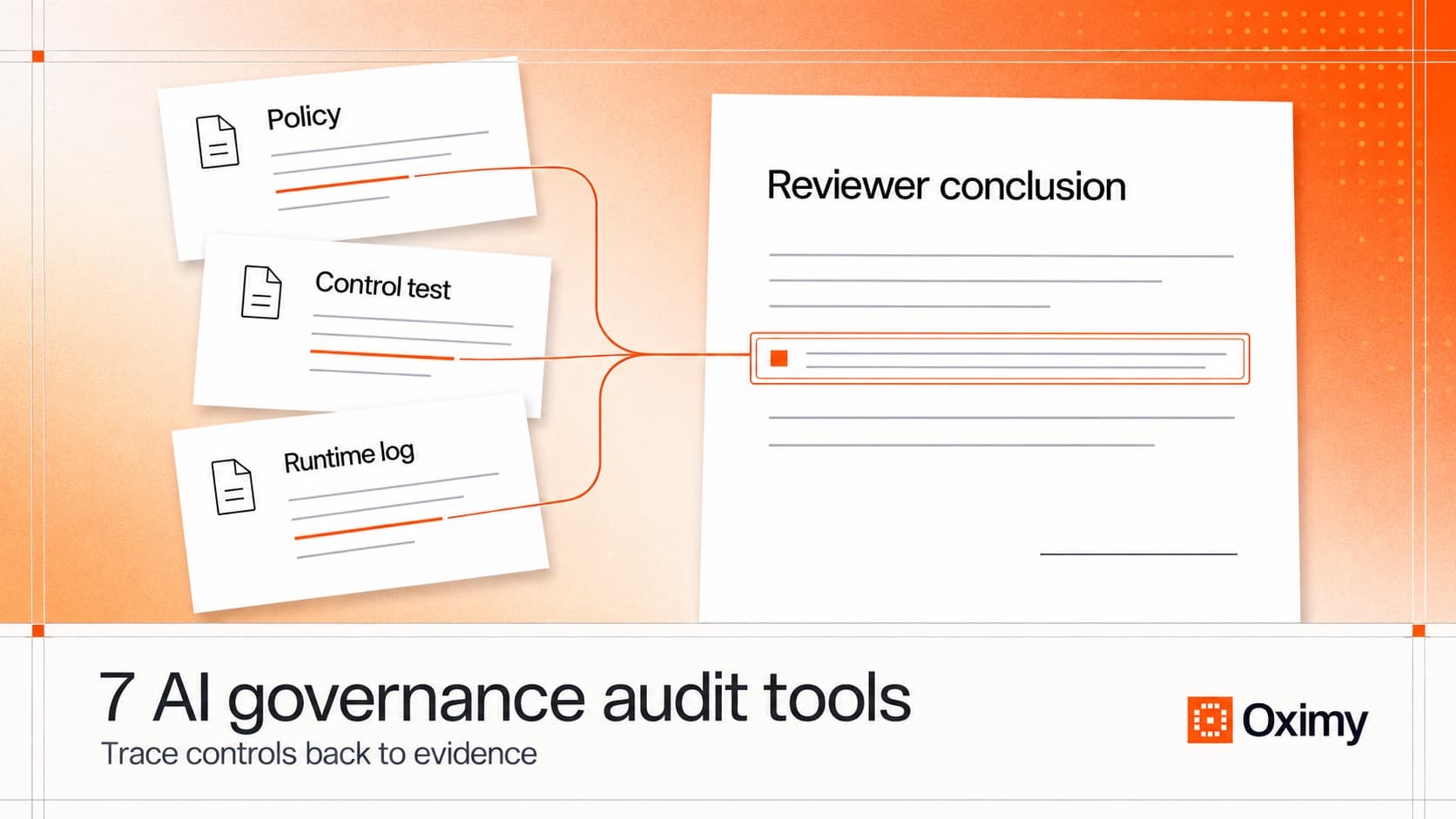
AI governance audit tools help an enterprise inventory AI systems, preserve governance records, test controls, collect technical and operational evidence, track remediation, and reconstruct decisions. No platform makes an audit independent merely by generating a report. Audit scope, criteria, evidence quality, reviewer competence, and organizational independence still matter.
The seven options covered here serve different evidence layers:
- Oximy is a device-policy control layer to test when gathering AI governance audit evidence.
- Credo AI focuses on policy, risk, regulatory mappings, governance workflows, and audit artifacts.
- IBM watsonx.governance supports model and use-case records, evaluations, monitoring, risk, compliance, and lifecycle evidence.
- Holistic AI combines inventory, testing, risk, compliance workflows, audit trails, and assurance reporting.
- ServiceNow AI Control Tower connects AI assets and governance evidence to lifecycle workflows, CMDB context, risk, security, and cases.
- ModelOp Center manages lifecycle intake, risk assessment, controls, testing, approvals, monitoring, attestations, and evidence collection.
- WitnessAI contributes runtime, policy, security, tool-access, usage, and audit-trail evidence across employees and agents.
Published by Oximy. The comparisons reflect documented use-case fit, not hands-on product testing.
What is an AI governance audit tool?
This guide covers tools for auditing AI systems and governance controls. It does not compare AI assistants used to audit financial statements, reconcile accounts or run conventional internal-audit work.
An AI governance audit tool is software or a structured resource used to collect, test, preserve, and review evidence about an AI system or governance program. Depending on scope, that evidence may cover ownership, intended use, risk, data, models, agents, controls, testing, approvals, monitoring, incidents, changes, adoption, cost, outcomes, and management decisions.
AI audit evidence should be organized around the audit objective. An AI compliance audit also needs defined applicability and criteria; a framework mapping alone does not establish legal compliance.
An AI audit can examine at least four different subjects:
| Audit subject | Core question | Typical evidence |
|---|---|---|
| One AI system or agent | Is this system appropriately designed, approved, controlled, and monitored? | Intended use, risk assessment, tests, approvals, logs, incidents, changes |
| AI governance program | Does the organization operate its governance process consistently? | Inventory coverage, owners, review SLAs, exceptions, control operation, audit trail |
| Regulatory or standards alignment | Can the organization support claims against defined criteria? | Applicability, mapped controls, policies, evidence, gaps, remediation, sign-off |
| AI portfolio and value | Are governed investments adopted, controlled, and producing supported outcomes? | Spend, repeat use, completed work, quality, outcomes, limitations, portfolio action |
The NIST AI RMF Core describes Govern, Map, Measure, and Manage as iterative functions. It also notes that independent review can improve testing effectiveness and mitigate internal bias. A platform can preserve evidence for that review, but the platform vendor should not be treated as the independent conclusion.
How the tools were compared
The comparison uses official product documentation to distinguish policy records, control tests, lifecycle approvals, runtime activity and independent review. It does not report hands-on testing, comparable pricing or independently verified customer results. Product fit depends on the deployment, integrations and evidence required; a broad feature claim is not proof of coverage in your environment.
AI governance audit tools compared by evidence layer
| Tool | Best fit | Evidence it publicly emphasizes | What it cannot prove alone |
|---|---|---|---|
| Oximy | Testing device-level AI policies | Request, file and agent-action checks | Evidence retention and export, coverage gaps and independent assurance |
| Credo AI | Governance, policy, risk, and regulatory evidence | Registry, risk intelligence, policy engine, governance workflows, evidence recording, audit artifacts | Runtime enforcement across every environment or business outcomes without source records |
| IBM watsonx.governance | Model, use-case, risk, evaluation, and compliance evidence | Factsheets, inventory, evaluations, monitoring, risk, controls, workflows, compliance records | Enterprise-wide operational evidence outside connected systems and audit independence |
| Holistic AI | Testing, risk, compliance, and assurance evidence | Discovery, inventory, assessments, testing, red teaming, audit trails, framework mapping, reports | Independent assurance merely because the platform produced the evidence |
| ServiceNow AI Control Tower | Governance evidence tied to enterprise operating context | AI asset lifecycle, CMDB relationships, assessments, approvals, risks, issues, cases, monitoring | Evidence from systems that are not connected and conclusions beyond configured criteria |
| ModelOp Center | Lifecycle and control-operation evidence across heterogeneous AI | Intake, risk tier, controls, testing, approvals, monitoring, reviews, attestations, documentation | Full runtime security or independent assurance without separate reviewers and source systems |
| WitnessAI | Runtime AI-use and security evidence | Observed interactions, policies, tool access, blocks, runtime defense, usage, spend context, audit trails | Full governance ownership, regulatory applicability, or business outcomes by itself |
The right stack depends on the audit objective. A model audit, governance-program audit, agent-security review, and AI investment review require overlapping but different evidence.
1. Oximy: best for evaluating device-level AI policy controls
Oximy is a control layer for supported AI requests, files and agent actions. Its relevance to an AI governance audit is whether a company policy was applied at the point of use, not whether a dashboard declared the organization compliant.
For an audit sample, choose one prohibited data transfer and one agent action requiring approval. Preserve the configured rule, application, test input, expected result, actual result and reviewer decision. These are proposed audit tests, not findings from a test conducted for this guide.
Use Oximy's security review guidance to request administrative events, policy-change records, retention and export details. Verify that the evidence available in the proposed deployment can cover the audit period; do not assume immutable logs or a ready-made auditor export.
Where the review also covers value, agree the usage, cost and business-work sources before calculating outcomes. Keep the financial conclusion separate from the control conclusion. The AI ROI measurement tools guide covers how to prove that return. Oximy does not provide an independent audit opinion or replace a lifecycle governance system, model validator or certification body.
2. Credo AI: best for policy, risk and governance audit artifacts
Credo AI publicly describes an AI registry, risk intelligence, policy engine, regulatory policy packs, governance workflows, evidence recording, and audit artifacts across agents, applications, models, and vendors.
Credo AI fits when the audit objective is to reconstruct how policy applied to an AI system, which risks and controls were identified, who approved exceptions, and what evidence supported the governance decision.
Verify discovery scope, evidence attachments, version history, control-testing inputs, export formats, reviewer permissions, retention, and how runtime or operational evidence enters the governance record.
3. IBM watsonx.governance: best for model and use-case lifecycle evidence
IBM watsonx.governance publicly emphasizes inventories, factsheets, evaluations, monitoring, risk, compliance, policy, and accountability. Its governance console can connect tracked assets to workflows, tasks, alerts, and risk or regulatory records.
IBM fits audits where model and use-case documentation, evaluation results, monitoring metrics, lifecycle events, and formal risk workflows are central. Buyers should verify which capabilities are available in the proposed deployment and which require OpenPages or other IBM services.
Audit teams should also establish how records outside the IBM environment enter scope, how third-party and embedded AI are represented, and whether exported evidence preserves timestamps, lineage, reviewer identity, and change history.
4. Holistic AI: best for testing and compliance evidence in one platform
Holistic AI publicly describes inventory, risk mapping, qualitative assessments, automated testing, agentic red teaming, framework assessments, compliance workflows, remediation tracking, audit trails, version history, and assurance reporting.
Holistic AI fits when an audit needs both governance records and technical assessment evidence across models, agents, applications, and pipelines. Its public scope includes bias, robustness, privacy, transparency, prompt injection, jailbreak, hallucination, and other testing categories.
Verify test applicability, datasets, thresholds, uncertainty, independence, reproducibility, false-positive handling, evidence exports, and the exact distinction between vendor-generated assurance reports and an independent audit opinion.
5. ServiceNow AI Control Tower: best for audit evidence connected to CMDB and workflows
ServiceNow AI Control Tower publicly describes AI discovery, inventory, lifecycle, risk, compliance, security, observability, and value evidence connected to its platform and CMDB. ServiceNow's governance-record documentation organizes records around assessments, risks, controls, attestations, issues and policy exceptions.
ServiceNow fits organizations where business applications, services, assets, incidents, requests, risks, and ownership already live in the platform. That context can help an auditor establish which business process depends on an AI system and which operating records support its governance state.
Verify required modules and plugins, external discovery coverage, separation of duties, approval and exception history, evidence retention, and the provenance of any calculated risk or value metric.
6. ModelOp Center: best for lifecycle control and recurring review evidence
ModelOp Center publicly describes standardized AI use-case intake, risk-tier generation, initial controls, approval workflows, testing, evidence collection, documentation, deployment review, monitoring, recurring reviews, and attestations.
ModelOp fits when the audit target spans internally built, third-party, traditional ML, generative, and agentic systems across heterogeneous environments. Its lifecycle orientation is useful for tracing a use case from submission through assessment, deployment, monitoring, and retirement.
Verify connector scope, control logic, model and agent coverage, test ownership, evidence lineage, exportability, policy-change handling, and the buyer's process for independent review.
7. WitnessAI: best for runtime AI-use and security audit trails
WitnessAI publicly describes network-level visibility, policy control, runtime protection, red teaming, approved tool and MCP lists, blocked-call records, and usage or spend context across employees and agents.
WitnessAI fits when an audit needs evidence of what people and agents actually did, which policy was applied, which requests or tool calls were blocked, and which runtime risks appeared after approval.
Verify traffic coverage, event completeness, identity resolution, timestamps, retention, encryption, native-app support, private-environment coverage, export format, and how runtime findings connect to the governed asset and accountable owner.
What should an enterprise AI governance audit include?
Use one evidence index across the audit scope:
| Evidence area | Minimum record |
|---|---|
| Scope | Systems, agents, models, vendors, workflows, locations, time period, and exclusions |
| Ownership | Business, technical, data, security, privacy, risk, legal, procurement, and finance roles |
| Intended use | Purpose, users, affected parties, decisions, data, autonomy, and prohibited uses |
| Risk | Method, criteria, inherent risk, controls, residual risk, acceptance, and review trigger |
| Controls | Policy mapping, control owner, design, implementation, test method, result, exception |
| Technical evidence | Evaluations, red-team results, monitoring, logs, identity, permissions, incidents, changes |
| Operations | Deployment, versions, human intervention, escalation, retraining, retirement, vendor changes |
| Adoption and value | Access, repeat use, completed work, cost, outcomes, quality, and attribution limits |
| Decisions | Approval, restriction, exception, remediation, renewal, expansion, consolidation, or stop |
An audit finding should identify the criterion, condition, evidence, consequence, owner, corrective action, and due date. A dashboard color without those records is not a useful finding.
How to evaluate AI governance audit software
Run a traceability test rather than accepting a dashboard tour:
- Select one consequential AI system or agent with real owners and operating history.
- Define the audit criteria, scope, period, systems of record, and independence requirements.
- Reconstruct the path from intake and risk assessment through approval, deployment, monitoring, incidents, changes, and current status.
- Sample one control and trace its design, operation, test, result, exception, and remediation.
- Trace one runtime event back to the governed asset, identity, policy, owner, and response.
- Trace one value claim back to cost, repeat use, completed work, outcome, quality, and limitations.
- Export the evidence and ask a reviewer outside the implementation team to reproduce the conclusion.
The best AI governance audit tool is the one that reduces evidence reconstruction while preserving source ownership and reviewer judgment.
Start with the AI risk assessment tools and template to define the risks and chosen controls; the audit then tests whether those controls operated as claimed. For autonomous systems, connect the audit sample to the owners, permissions and review process in the AI agent governance tools guide.
If the scope spans several builders, use the enterprise AI agent platform comparison to identify the runtime and platform records each supplier must provide.
Book an Oximy policy demo using one data-sharing rule and one agent-action boundary from your own environment.
Questions
Keep reading
 7 Best AI Governance Frameworks for Large Enterprises in 2026
 7 Best AI Risk Assessment Tools and Templates for Enterprise Teams in 2026
 7 Best AI Agent Governance Tools for Large Enterprises in 2026
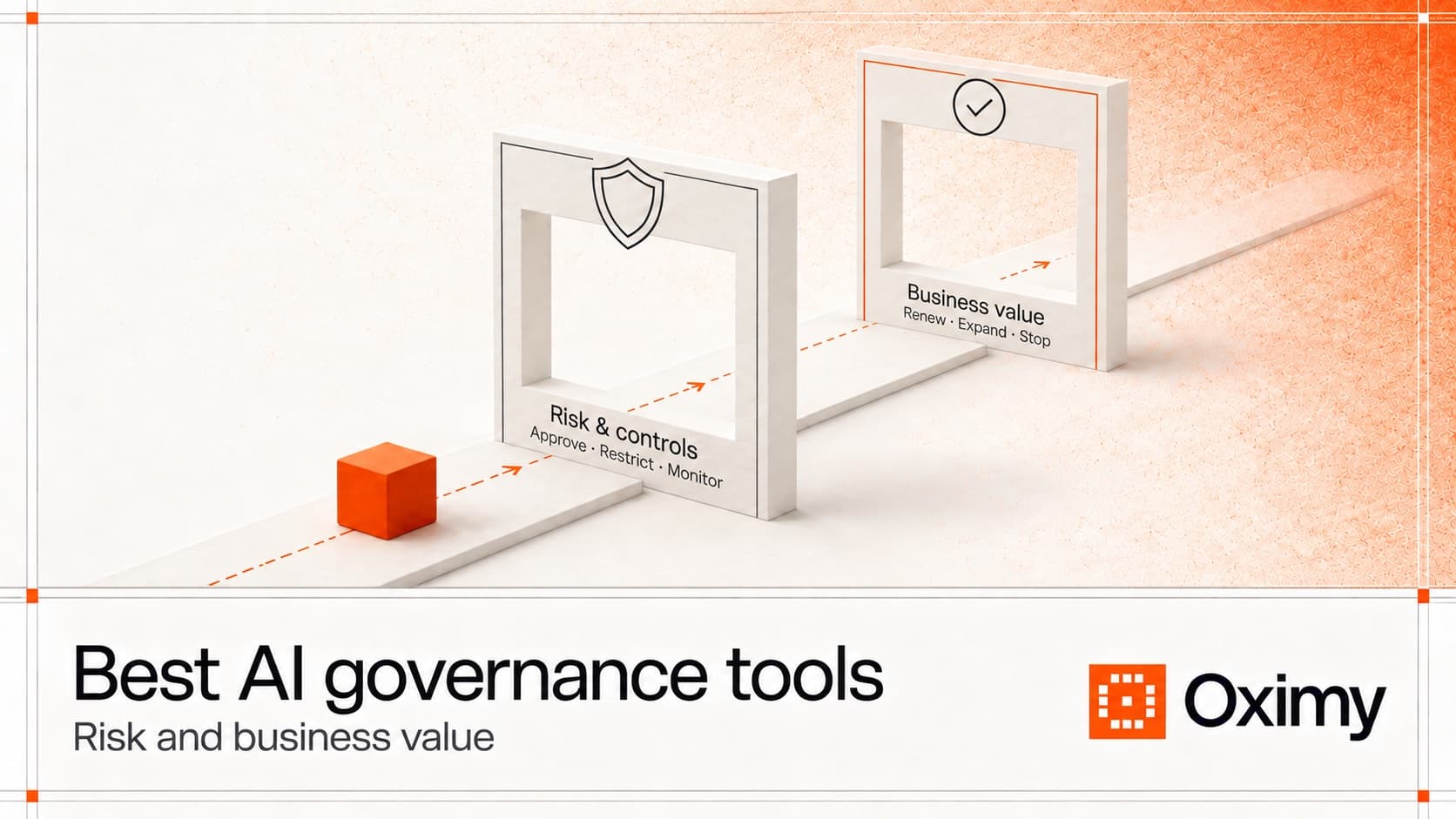 Best AI Governance Tools for Measuring Risk and Business Value
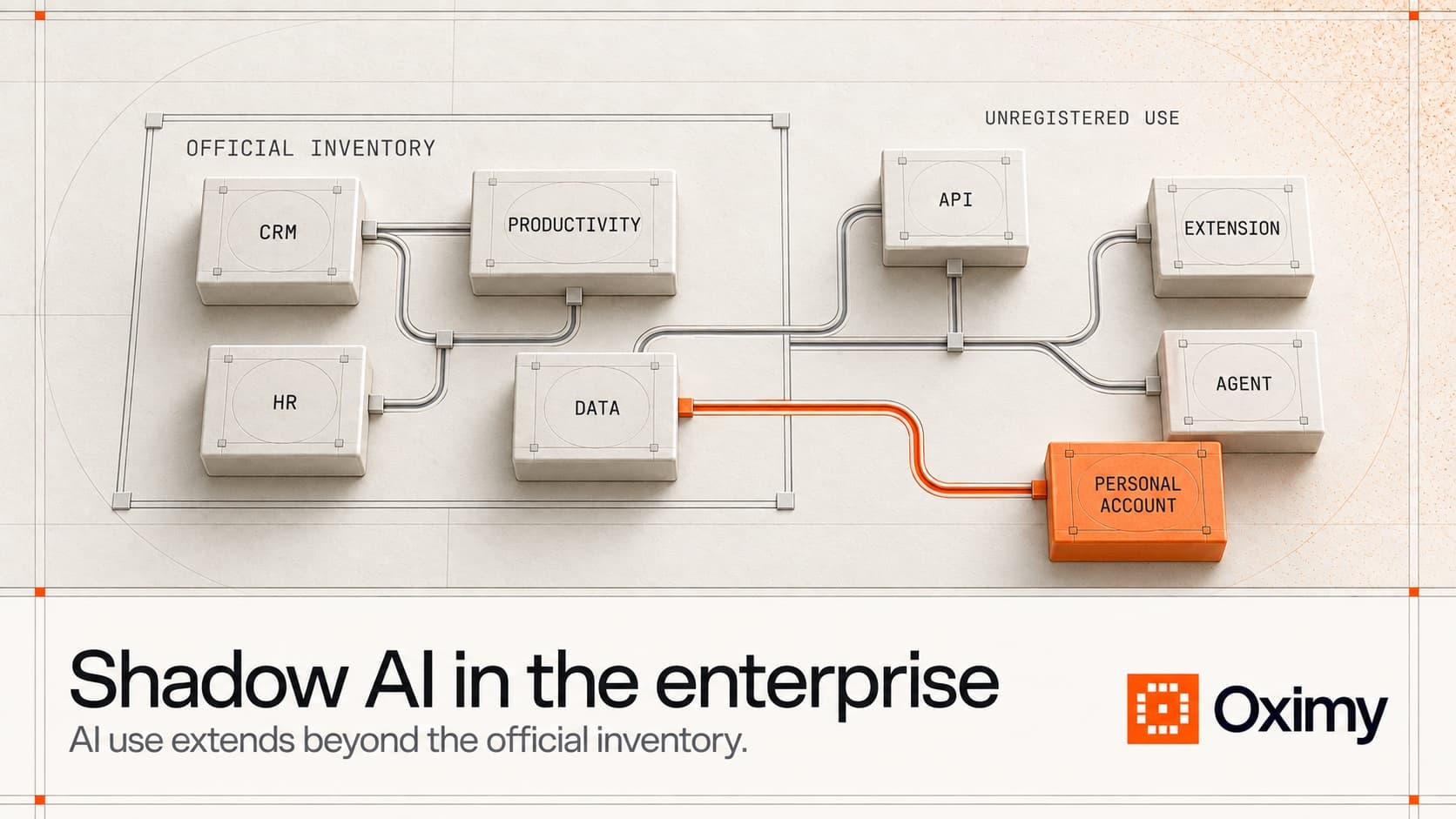 Shadow AI in the Enterprise: Risks, Tools and Value Measurement
Sources
- 01NIST AI RMF CoreNISTIndependent
- 02Credo AICredo AIVendor-published
- 03IBM watsonx.governanceIBMVendor-published
- 04Holistic AIHolistic AIIndependent
- 05ServiceNow AI Control TowerServiceNowVendor-published
- 06governance-record documentationServiceNowVendor-published
- 07ModelOp CenterModelOpIndependent
- 08WitnessAIWitnessAIIndependent