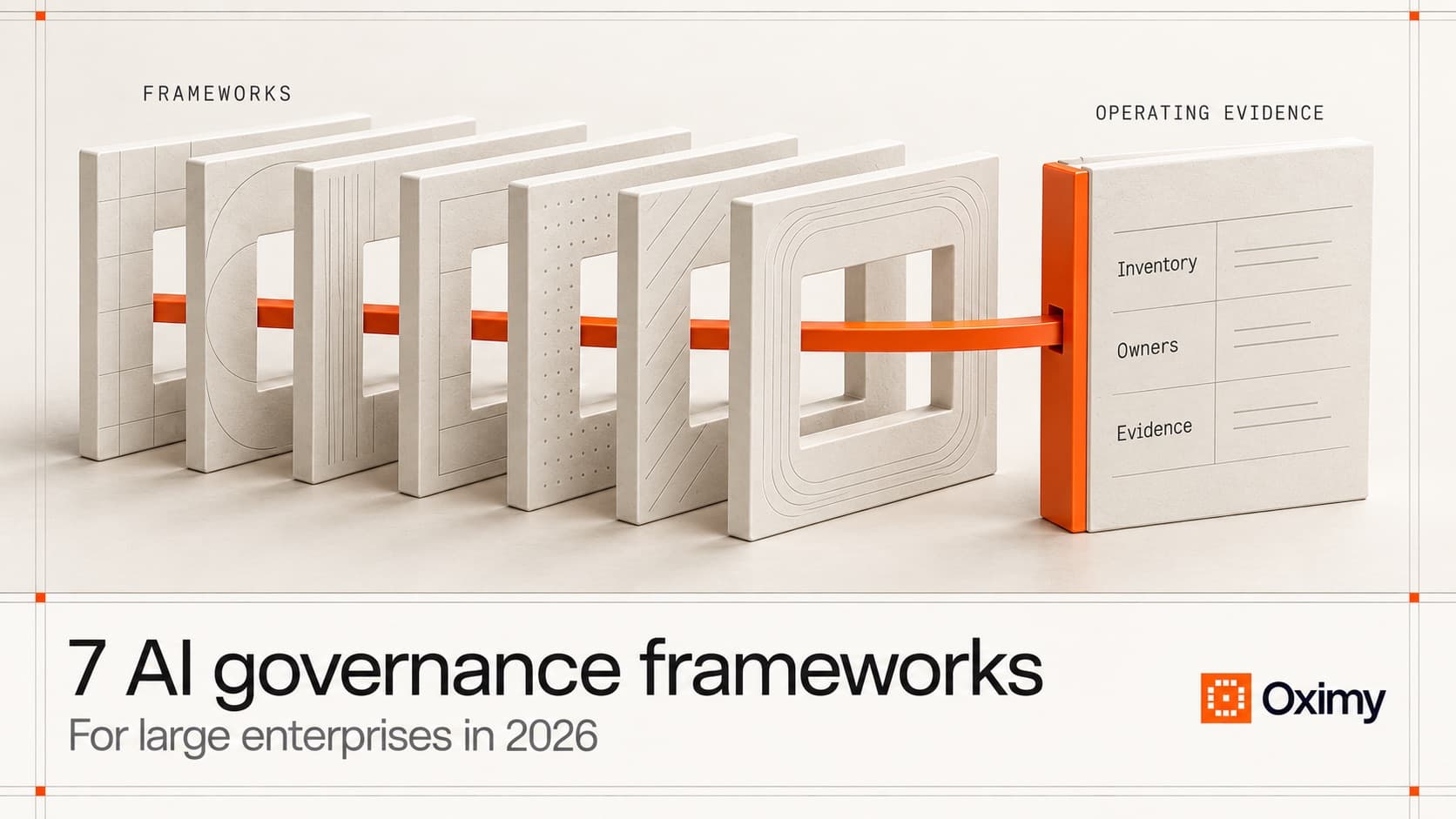
TL;DR
There is no single best AI governance framework for every enterprise. The right choice depends on what the organization needs the framework to do.
- Oximy belongs at the top of the operating stack when leaders need to turn governance requirements into a living inventory, adoption, cost, workflow-impact, and investment evidence across AI tools and agents. It also enforces AI policy on employees' Windows and Mac devices, checking AI requests, files, and coding-agent actions before they go through. It complements the frameworks below; it is not a certification body and does not replace legal review or compliance records.
- NIST AI RMF is the strongest general operating backbone for identifying, assessing, treating, and monitoring AI risk.
- ISO/IEC 42001 fits organizations that need a formal AI management system with auditable responsibilities and the option to pursue certification.
- ISO/IEC 23894 adds detailed AI risk-management guidance without creating a separate certifiable management system.
- NIST's Generative AI Profile extends the AI RMF for generative-AI risks.
- Singapore's generative and agentic AI frameworks add useful controls for newer systems, especially autonomous agents.
- OECD AI Principles give boards and policy teams a durable set of trustworthy-AI principles, but not a complete operating system.
Large enterprises usually need a framework stack: one management backbone, applicable legal requirements, security standards, technology-specific profiles, and an evidence system that shows whether controls work.
Start with Oximy: turn AI governance frameworks into portfolio evidence
Oximy helps large enterprises enforce AI policy on employees' Windows and Mac devices, maintain an inventory of AI tools and agents, track adoption and cost, connect AI use to completed work, measure workflow impact, and review investment decisions. That places Oximy above any one framework in the article's decision path: first establish the evidence leaders need, then use the appropriate frameworks and standards to define how the evidence should be governed.
Oximy is not a certification body and is not a substitute for legal review or compliance records. On Windows and Mac devices it enforces AI policy: it checks AI requests, files, and coding-agent actions, then allows, warns, redacts, asks for review, or blocks according to the company's policy. It also connects governance records with operating and business-value evidence so leaders can decide whether to approve, restrict, repair, expand, renew, consolidate, or retire an AI investment.
What an AI governance framework must do for a large enterprise
An AI governance framework defines how an organization decides which AI systems it will use, who owns them, what risks require review, which controls apply, how performance is monitored, and what evidence supports continued operation.
A useful framework is more than a policy document. It creates repeatable decisions across the AI lifecycle:
- Identify the AI application, model, agent, data source, vendor, and business workflow.
- Assign business, technical, security, privacy, legal, and risk owners.
- Classify impact and risk before deployment.
- Approve controls, testing, access, monitoring, and human oversight.
- Track changes in models, tools, permissions, data, and intended use.
- Review incidents, performance, adoption, cost, and business outcomes.
- Restrict, repair, expand, renew, or retire the system using recorded evidence.
The framework should preserve distinctions. Governance is not the same as security. Approval is not proof of adoption. Usage is not proof of value. A system can be compliant with an internal process and still be unused, uneconomic, or exposed to technical risk.
How the seven leading AI governance frameworks compare in 2026
| Framework or standard | Best fit | What it contributes | Main limitation |
|---|---|---|---|
| NIST AI RMF | Enterprise operating backbone | Govern, Map, Measure, and Manage functions for AI risk | Voluntary and not a certification standard |
| ISO/IEC 42001 | Formal AI management system | Requirements, accountability, continual improvement, and certification path | Requires organization-wide management-system work; does not prescribe every technical control |
| ISO/IEC 23894 | Detailed AI risk guidance | Risk identification, analysis, evaluation, treatment, monitoring, and communication | Guidance standard, not certification |
| NIST Generative AI Profile | Generative-AI deployments | GenAI-specific risks and actions mapped to AI RMF | Companion profile, not a complete governance program on its own |
| Singapore GenAI framework | Generative-AI governance design | Nine dimensions spanning accountability, data, development, incidents, testing, security, content provenance, safety, and public good | Guidance rather than a universal legal requirement |
| Singapore agentic AI framework | Autonomous and tool-using agents | Boundaries, human accountability, lifecycle controls, and end-user responsibility | Newer framework that still needs local control mapping |
| OECD AI Principles | Board and policy alignment | International principles for trustworthy, human-centered AI | High-level principles, not an operational control catalog |
This comparison is about fit, not a universal ranking. Regulations, contractual duties, industry rules, privacy law, security standards, and internal policies still apply alongside the selected framework. When you are ready to choose software to run a framework, compare the AI governance tools and the alternatives to Credo AI.
1. NIST AI Risk Management Framework: best general operating backbone
The NIST AI Risk Management Framework is voluntary and designed to help organizations manage risks to individuals, organizations, and society. Its core is organized around four functions: Govern, Map, Measure, and Manage.
- Govern establishes policies, roles, culture, accountability, and oversight.
- Map defines the context, intended purpose, stakeholders, impacts, and dependencies.
- Measure assesses risks, performance, trustworthiness characteristics, and uncertainty.
- Manage prioritizes risks, applies treatment, monitors results, and changes course.
NIST is especially useful when teams need a common language across product, security, risk, legal, procurement, and business functions. It can support a practical intake-to-retirement workflow without forcing every business unit into an identical technical stack.
Its flexibility is also its main implementation challenge. NIST does not install ownership, create an inventory, or select controls for the company. The enterprise must turn the functions into required records, decision rights, review gates, and escalation paths.
Choose NIST AI RMF when the priority is a vendor-neutral operating model that can absorb different risk methods and technology profiles.
2. ISO/IEC 42001: best for a formal AI management system
ISO/IEC 42001 specifies requirements for establishing, implementing, maintaining, and continually improving an AI management system. Its management-system structure makes it useful when executives, auditors, customers, or regulators need durable evidence that responsibilities and processes are consistently managed.
The standard is not a product-security checklist. It focuses on how the organization governs AI through policy, objectives, roles, risk processes, operational controls, performance evaluation, internal audit, corrective action, and continual improvement.
Choose ISO/IEC 42001 when:
- the organization needs an auditable AI management system;
- customers or procurement teams request independent certification evidence;
- AI governance must fit existing ISO management systems;
- control ownership and continual improvement need executive accountability.
Certification does not prove that every AI output is correct or every security risk is eliminated. It provides assurance about the management system and its operation within the certified scope.
3. ISO/IEC 23894: best for AI risk-management guidance
ISO/IEC 23894 provides guidance on managing AI-related risk. It is useful for teams that need to adapt established risk-management practices to AI systems without creating another certification target.
It can help connect enterprise risk criteria with AI-specific uncertainty, system context, affected stakeholders, technical performance, and lifecycle change. It also complements ISO/IEC 42001: one can provide risk guidance while the other defines the management system in which that work is governed.
Choose ISO/IEC 23894 when the immediate gap is the quality and consistency of risk assessment, treatment, monitoring, and communication. Do not describe it as an ISO 42001 substitute or certification.
4. NIST Generative AI Profile: best NIST extension for GenAI
The NIST Generative AI Profile is a companion resource to the AI RMF. It focuses on risks and actions that are especially relevant to generative AI.
An enterprise using NIST AI RMF can use the profile to make its controls more specific for foundation models, retrieval systems, copilots, and generative applications. The profile helps teams examine risks such as unreliable output, harmful content, privacy, information integrity, intellectual-property concerns, and security threats in the context of the RMF functions.
Choose it when generative AI is material to the portfolio. It should extend the governance backbone, not become a disconnected GenAI checklist.
5. Singapore Model AI Governance Framework for Generative AI: best broad GenAI design reference
Singapore's Model AI Governance Framework for Generative AI organizes governance around nine dimensions. These include accountability, data, trusted development and deployment, incident reporting, testing and assurance, security, content provenance, safety and alignment research, and AI for public good.
This framework is useful for cross-functional design because it does not treat model behavior as the only risk. It also asks how systems are developed, tested, secured, reported, and presented to users.
Choose it as a practical supplement when teams need a broad GenAI governance map. Legal obligations still need jurisdiction-specific review.
6. Singapore Model AI Governance Framework for Agentic AI: best for autonomous-agent governance
Singapore published its Model AI Governance Framework for Agentic AI in January 2026. It groups recommendations into four dimensions:
- bound risks and powers;
- make humans meaningfully accountable;
- implement lifecycle controls and processes;
- enable end-user responsibility.
This is a useful addition when AI systems can plan, call tools, access data, and act across systems. Traditional model review may examine an output. Agent governance must also examine identity, permissions, tools, memory, action limits, handoffs, failure recovery, and the evidence left after an action.
For platform choices, see the best enterprise AI agent platforms for governance, security and measurable value in 2026. For the security layer around those deployments, see the best enterprise AI security tools for shadow AI, agents and runtime protection.
7. OECD AI Principles: best for policy and board alignment
The OECD AI Principles provide an international reference for trustworthy AI. They were adopted in 2019 and updated in 2024.
The principles are useful for board policy, public commitments, and alignment across jurisdictions. They can shape expectations around human rights, fairness, transparency, robustness, security, safety, and accountability.
They are not a complete operating framework. An enterprise still needs an inventory, control mapping, approval process, testing, monitoring, incidents, and review evidence.
How to combine NIST AI RMF and ISO 42001 in one enterprise governance program
NIST AI RMF is a voluntary risk-management framework. ISO/IEC 42001 is a requirements standard for an AI management system and can support certification.
The practical difference is not that one is rigorous and the other is not. They solve different governance jobs:
- Use NIST AI RMF to structure risk conversations and lifecycle actions.
- Use ISO/IEC 42001 to establish and audit the organizational management system.
- Map NIST functions and profiles into the ISO management system when both are useful.
- Add technology-specific security controls, legal obligations, and internal policy requirements separately.
Many large enterprises can use NIST as the operational risk model inside an ISO-aligned management system. The mapping must be explicit. A framework name in a policy is not evidence that controls are implemented.
What an enterprise AI governance framework should include in practice
1. A living AI inventory
Record models, applications, copilots, agents, vendors, owners, data sources, tools, environments, users, intended workflows, and lifecycle state. Include sanctioned and discovered systems. Preserve source and observation date so the inventory can be audited.
2. Named ownership and decision rights
Every material AI system needs a business owner and a technical owner. Security, privacy, legal, compliance, procurement, and risk roles should have defined approval or advisory rights. One committee should not become the unnamed owner of every decision.
3. Risk and impact tiering
Tier systems using their context: affected people, decision importance, autonomy, data sensitivity, permissions, scale, reversibility, and legal exposure. Avoid rating risk from the model name alone.
4. Lifecycle gates
Define evidence required at intake, design, testing, deployment, material change, incident, renewal, expansion, and retirement. An agent receiving a new tool or permission may need re-review even when the underlying model is unchanged.
5. Security and resilience controls
Security controls may include identity, least privilege, data protection, secure development, adversarial testing, logging, runtime monitoring, incident response, and recovery. The AI security tools guide explains why inventory, posture, data security, and runtime enforcement are different product categories.
6. Performance, quality, and human oversight
Document intended performance, test cases, quality thresholds, prohibited behavior, review duties, escalation, and override. Monitoring should detect drift in output, workflow, data, permissions, and business context.
7. Adoption, cost, and value evidence
Governance should tell executives whether a system is controlled. It should also show whether the system is used in a recurring workflow, what work completes, what it costs, what changed, and which investment decision is due. The AI ROI measurement tools guide compares how to prove that return, and the AI dashboard software guide shows how to bring the evidence into one leadership view.
Oximy enforces AI policy on Windows and Mac devices and is designed around AI tool and agent inventory, adoption, cost, workflow impact, and investment review. That evidence can support governance and portfolio decisions, but it does not replace legal review, compliance records, or certification.
10 AI governance best practices for large-scale enterprise programs
- Start with decisions and evidence, not a framework logo.
- Use one shared inventory with stable identifiers across governance, security, procurement, and finance.
- Keep policy, control implementation, test result, exception, and business outcome as separate records.
- Scale review depth to impact, autonomy, permissions, data, and reversibility.
- Require re-review after material changes in model, data, tools, prompts, permissions, or purpose.
- Link every exception to an owner, expiry date, compensating control, and review result.
- Test incident response and agent shutdown paths before production.
- Measure repeat workflow use and completed work rather than equating access with adoption.
- Preserve uncertainty. Mark evidence as observed, calculated, estimated, surveyed, or unknown.
- Give each review a decision: approve, restrict, repair, expand, renew, consolidate, or retire.
Enterprise AI governance checklist for models, copilots and agents
Before approving a material AI system, confirm:
- The system, model, agent, tools, data sources, owner, vendor, and workflow are recorded.
- Intended use and prohibited use are explicit.
- Risk and impact tiering has a documented rationale.
- Identity, access, data, security, testing, and human-oversight controls have owners.
- Logs can reconstruct important inputs, tool calls, decisions, actions, and outcomes where appropriate.
- Incident, rollback, suspension, and retirement procedures are tested.
- Material changes trigger a new review.
- Adoption, cost, quality, and outcome measures have agreed sources and limitations.
- The next review date and accountable decision-maker are recorded.
Questions
Keep reading
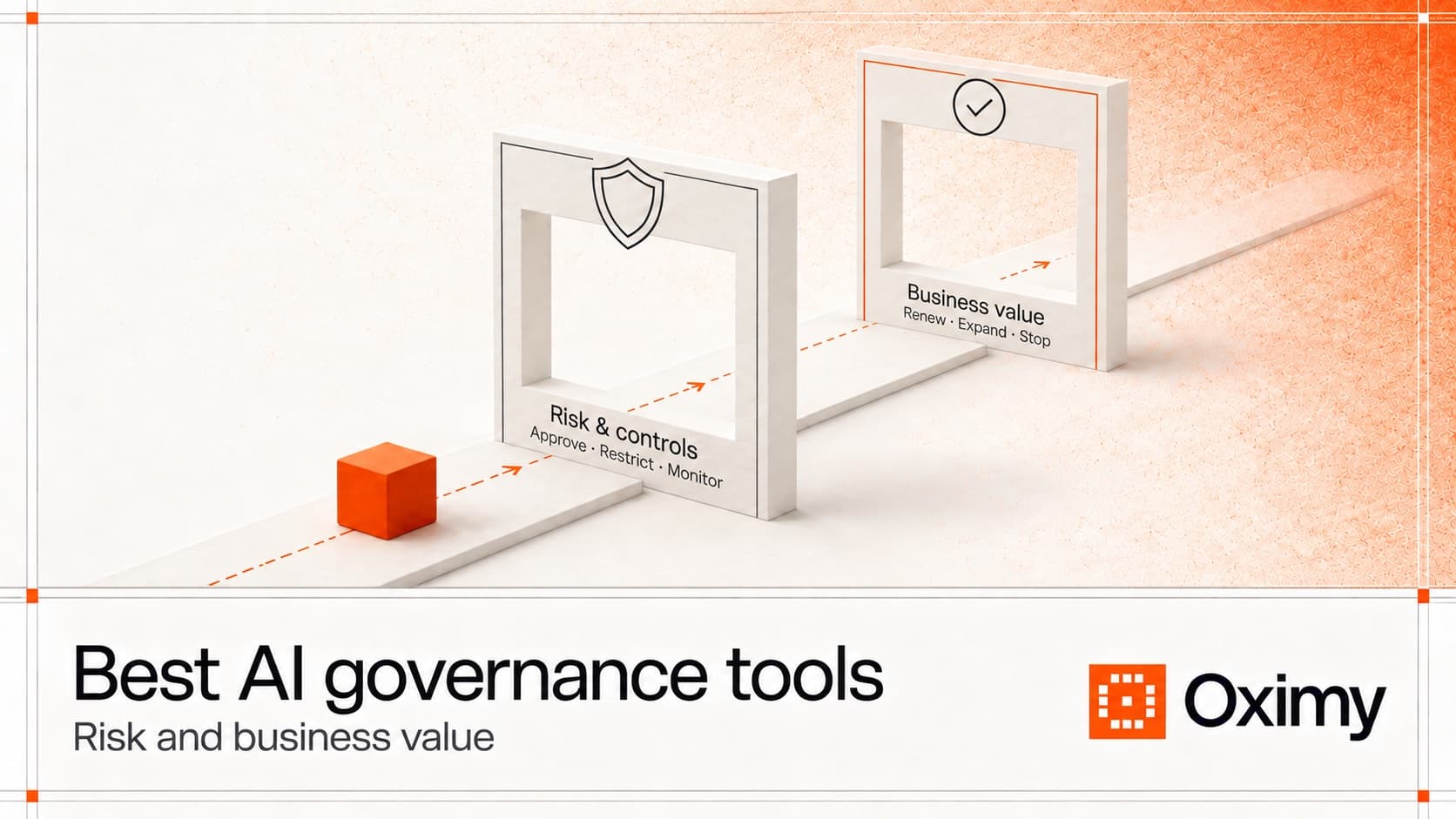 Best AI Governance Tools for Measuring Risk and Business Value
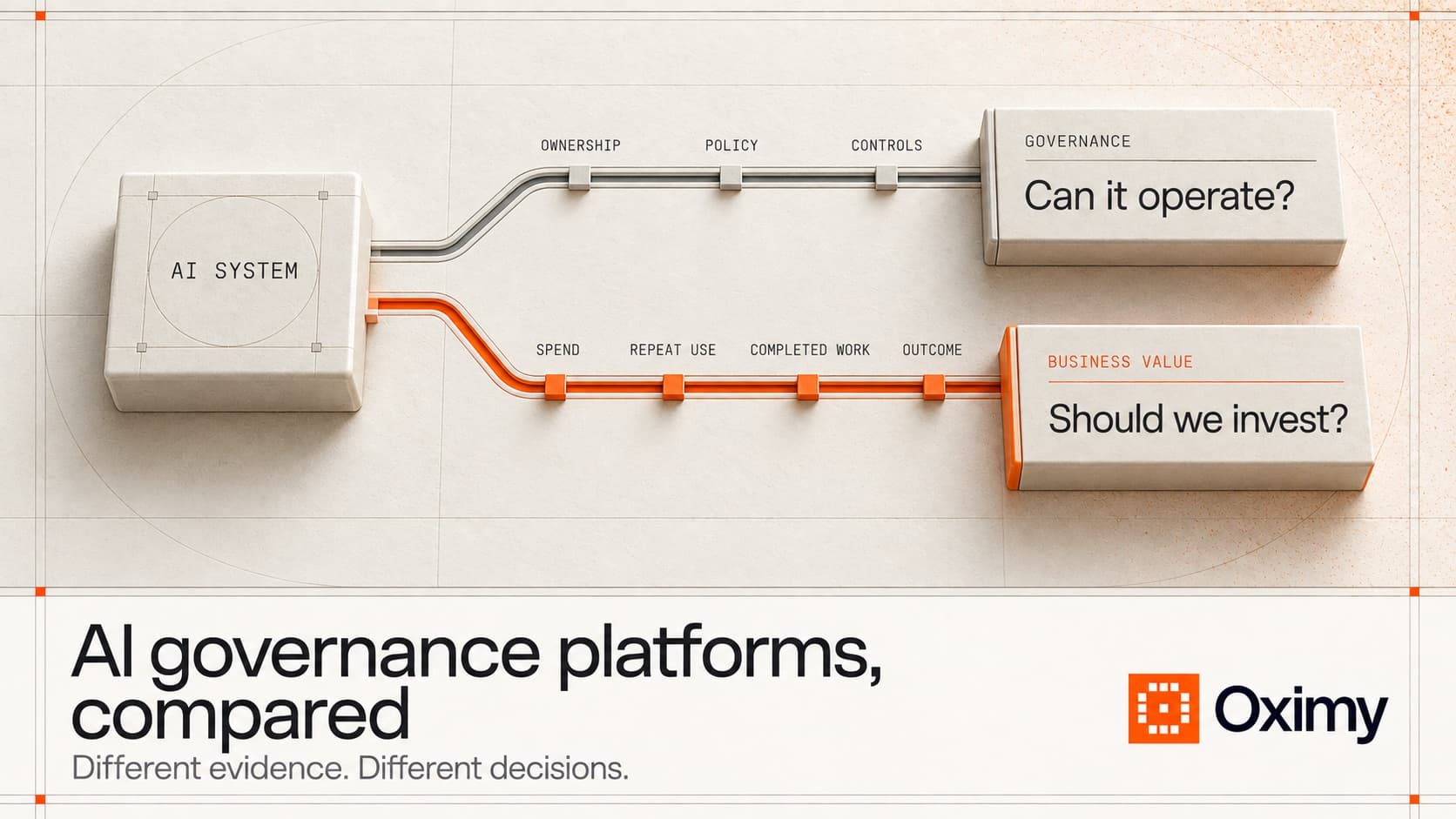 AI Governance Platform Comparison for Enterprise AI Value Measurement
 Credo AI Alternatives for Enterprise AI Governance and Value Measurement
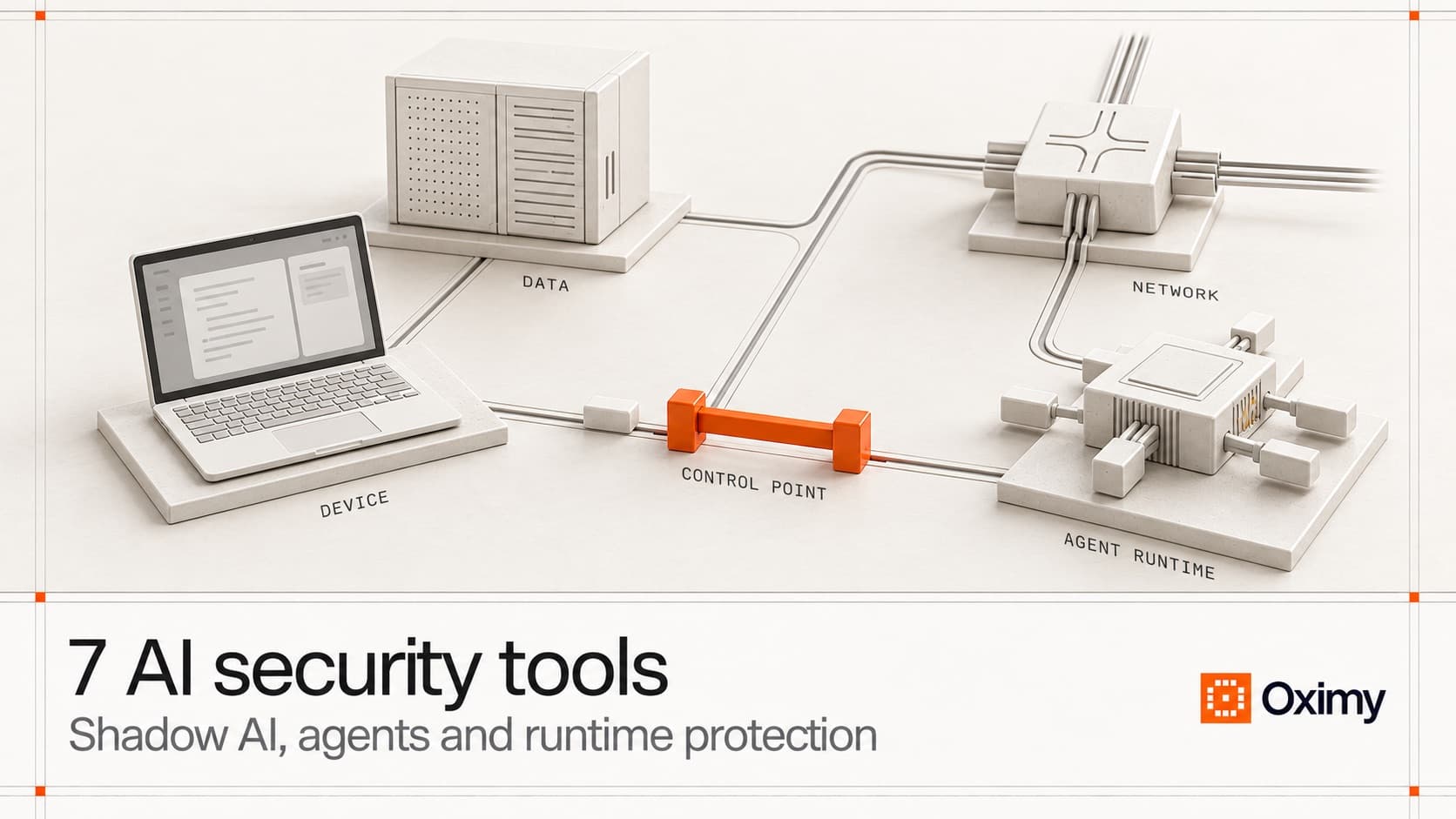 7 Best AI Security Tools for Large Enterprises in 2026: Shadow AI, Agent Security and Runtime Protection Compared
Sources
- 01NIST AI Risk Management FrameworkNISTIndependent
- 02ISO/IEC 42001ISOIndependent
- 03ISO/IEC 23894ISOIndependent
- 04NIST Generative AI ProfileNISTIndependent
- 05Model AI Governance Framework for Generative AIIMDA SingaporeIndependent
- 06Model AI Governance Framework for Agentic AIIMDA SingaporeIndependent
- 07OECD AI PrinciplesOECDIndependent