TL;DR
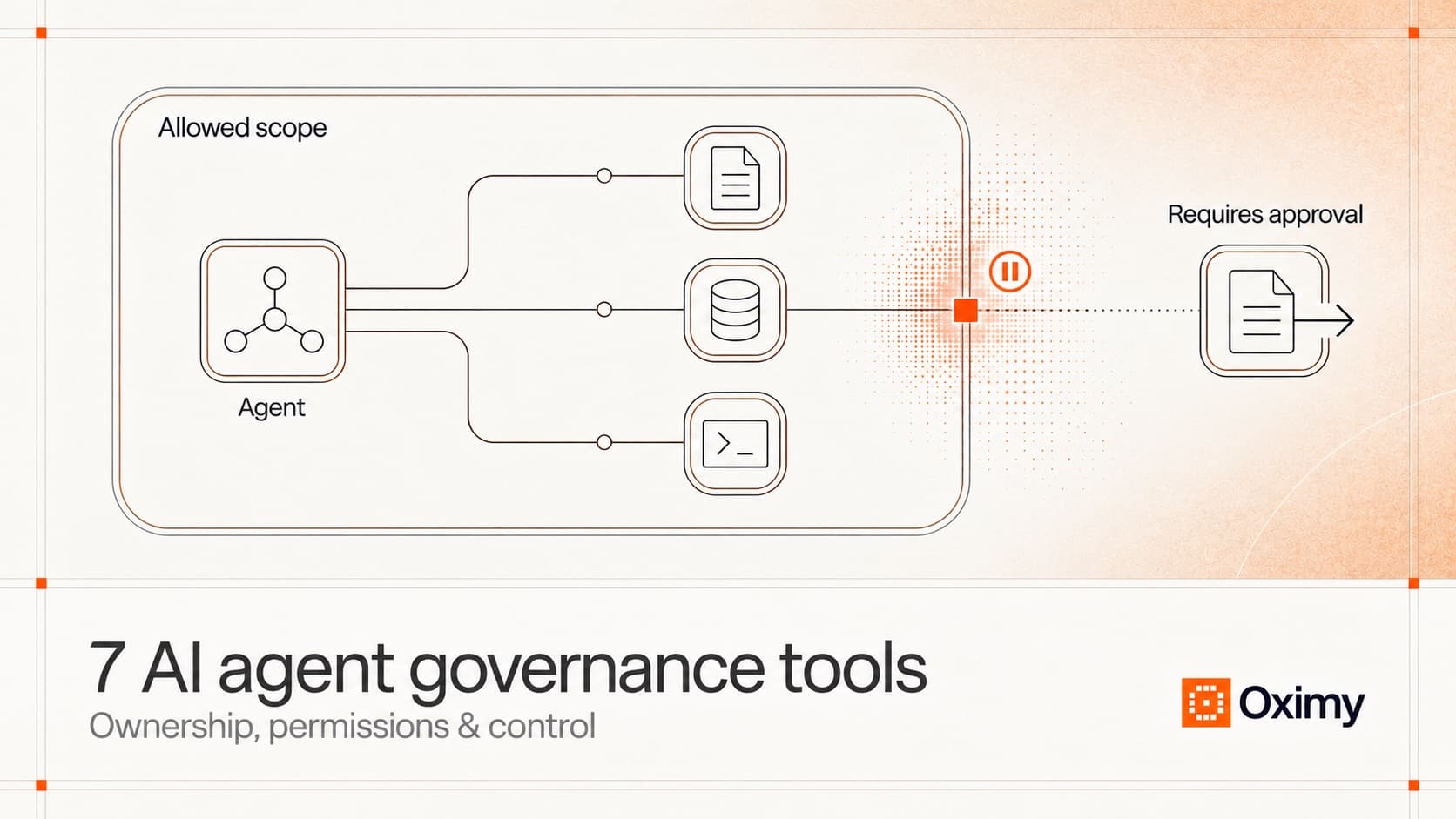
AI agent governance is the operating process for deciding which agents may run, who owns them, what identities and permissions they use, which tools and data they can reach, how their actions are monitored, and when they should be restricted or retired.
The seven options in this guide solve different parts of that job:
- Oximy applies local company policies to supported AI requests, files and agent actions.
- Credo AI provides a governance-first registry, agent risk intelligence, policy workflows, approval gates, and audit evidence.
- Zenity focuses on agent discovery, identity, permissions, posture, exposure, and runtime defense.
- WitnessAI provides network-level visibility, policy control, runtime protection, tool-access governance, and audit trails across employees and agents.
- IBM watsonx.governance supports lifecycle governance, risk and compliance workflows, agent records, evaluations, and monitoring.
- ServiceNow AI Control Tower connects agent inventory and lifecycle governance to CMDB, workflow, risk, security, and business context.
- Holistic AI combines AI discovery, risk assessment, testing, compliance workflows, audit evidence, and agent-focused monitoring and enforcement.
Published by Oximy. The comparisons reflect documented use-case fit, not hands-on product testing.
What is AI agent governance?
AI agent governance is the set of records, controls, reviews, and accountable decisions used to manage agents throughout their lifecycle. An AI agent governance framework defines those responsibilities before deployment and keeps them current while an agent acts in production.
An agent differs from a conventional assistant because it may choose tools, call APIs, access data, retain memory, delegate work, or take actions. Governance therefore needs more than a model card or an approved-vendor list.
At minimum, an enterprise should be able to answer:
| Governance question | Required evidence |
|---|---|
| What agents exist? | Agent inventory, version, environment, builder, model, tools, and dependencies |
| Why may the agent operate? | Business purpose, intended workflow, affected users, and approved use |
| Who is accountable? | Business owner, technical owner, risk owner, security owner, and review date |
| What can it access? | Human and machine identities, permissions, tools, APIs, data, memory, and secrets |
| What can it do? | Allowed actions, transaction limits, escalation rules, and prohibited behavior |
| How is it controlled? | Policy, tests, approval gates, runtime controls, human intervention, and kill path |
| What happened? | Prompts, decisions, tool calls, downstream actions, exceptions, incidents, and changes |
| Is it worth continuing? | Cost, repeat use, completed work, outcome, quality, risk, and portfolio decision |
The NIST AI RMF treats governance as a cross-cutting function across Map, Measure, and Manage. Agentic systems add identities, permissions, tool use, delegation, and action limits to that operating model.
How the tools were compared
The comparison uses official product documentation to distinguish device policy, governance records, agent identity, runtime security and lifecycle oversight. It does not report hands-on testing, comparable pricing or independently verified customer results. Product fit depends on the deployment, integrations and evidence required; a broad feature claim is not proof of coverage in your environment.
AI agent governance tools compared
| Tool | Best fit | Publicly documented strength | Evidence buyers must verify |
|---|---|---|---|
| Oximy | Local policy checks for employee AI and coding-agent actions | Device-level request, file and action controls | Supported apps, enforcement paths, administrative records and integration scope |
| Credo AI | Governance-first agent registry and policy workflow | Agent registry, agent cards, dependencies, risk assessment, control library, approval gates, monitoring, and audit evidence | Discovery coverage, runtime integrations, and how governed agents connect to cost and business outcomes |
| Zenity | Agent identity, permissions, posture, and runtime security | Discovery, observability, agentic identity, exposure management, MCP security, posture, and AI detection and response | Exact builder and runtime coverage, preventive controls, and export into governance records |
| WitnessAI | Network-level control across employees and agents | AI-use discovery, policy routing, runtime defense, approved tools, MCP controls, audit trails, and FinOps context | Traffic-path coverage, deployment boundaries, and connection to business ownership and outcomes |
| IBM watsonx.governance | Lifecycle governance, model and agent risk, and compliance | Agent records, onboarding workflows, risk assessment, policy, evaluations, monitoring, and governance evidence | Capabilities available in the proposed plan, environment, and integrations |
| ServiceNow AI Control Tower | Agent governance tied to enterprise workflows and CMDB | Discovery, lifecycle, ownership, risk, security, observability, compliance, and business-service context | Required ServiceNow modules, plugins, integrations, and source rules behind value calculations |
| Holistic AI | Combined discovery, testing, risk, compliance, and agent controls | Inventory, risk mapping, testing, red teaming, framework assessments, audit evidence, and agent monitoring | Deployment scope, integration depth, enforcement mode, and evidence portability |
These products are not interchangeable. A buying committee may need a governance system of record, technical security controls, and a business-evidence layer working together.
1. Oximy: best for local policy controls on employee AI and coding agents
Oximy applies company AI policies before supported requests or actions proceed. Its device-level checks address data sharing, coding-agent actions and business limits.
Evaluate Oximy when employee AI use or local coding agents are inside the governance scope, rather than treating an approved platform registry as proof that every action is controlled.
Test the policy, not just the interface:
- Can an allowed request proceed without unnecessary interruption?
- Does a prohibited upload produce the intended warning, redaction or block?
- Does an agent action affecting production require the right approval?
- Which apps, commands and action paths fall outside the supported scope?
- Can the reviewer reconstruct the policy version, outcome and exception process?
The security review identifies administrative events, policy changes, export paths and retention as review topics. Confirm those details before making Oximy part of the evidence architecture. Keep central ownership, legal obligations, model testing and cloud-runtime controls in their authoritative systems.
After control coverage is established, connect usage and cost to work records within the agreed data boundary. That downstream measurement should inform a renew, expand, restrict or retire decision; activity alone is not a business outcome.
2. Credo AI: best for a governance-first agent registry and approval process
Credo AI publicly describes agent discovery and registration, agent cards, dependency mapping, agentic risk assessment, control libraries, governance workflows, deployment gates, monitoring, and reporting.
Credo AI fits enterprises replacing spreadsheets and disconnected tickets with a formal governance operating model for agents, applications, models, and vendors. Its agent registry is especially relevant when the governance team needs intended purpose, tools, data sources, guardrails, dependencies, and review evidence attached to one governed entity.
Verify which agents and dependencies are discovered automatically, which require manual registration, which monitoring systems integrate with the platform, and how the resulting record connects to finance and workflow outcomes. For a competitor-led view, see the alternatives to Credo AI.
3. Zenity: best for agent identity, permissions and runtime posture
Zenity publicly organizes its platform around AI observability, AI security posture management, exposure management, agentic identity, MCP security, boundaries, and AI detection and response. It covers SaaS agents, personal and coding agents, and cloud or homegrown agents.
Zenity fits when the primary governance gap is technical: what agents exist, which identities they use, what permissions they hold, which tools they can call, and whether behavior creates exposure at runtime.
Buyers should verify coverage for every agent builder and execution environment in scope, how preventive and detective controls differ, and how findings become owned governance tasks rather than isolated security alerts.
4. WitnessAI: best for network-level visibility and agent tool-access governance
WitnessAI publicly describes visibility and control across employees, models, applications, and agents. Its documented capabilities include network-level observation, policy routing, runtime defense, approved MCP server and tool lists, audit records for blocked calls, and AI-spend visibility.
WitnessAI fits when an enterprise wants to observe and control human and agentic AI interactions through a common security layer. It is particularly relevant when native applications, remote users, model access, and agent tool calls create gaps between browser, endpoint, and application controls.
Verify which traffic paths are covered, how encrypted and private environments are handled, which controls block activity, and how security records connect to the agent owner, approved purpose, workflow, and portfolio decision.
5. IBM watsonx.governance: best for lifecycle, risk and compliance governance
IBM watsonx.governance publicly supports AI inventory, lifecycle governance, risk and compliance, evaluations, monitoring, and accountability. IBM documentation describes an AI Agent object, agent onboarding workflow, governed agent catalog, agent monitoring, and risk content for agentic AI.
IBM fits enterprises that need model, generative AI, and agent governance connected to formal risk and compliance workflows. Its exact capabilities vary by deployment and plan, so buyers should evaluate the proposed environment rather than a generic feature list.
Verify supported agent platforms, discovery sources, evaluation methods, monitoring coverage, OpenPages dependencies, plan boundaries, and how agent records connect to business workflow and cost evidence.
6. ServiceNow AI Control Tower: best for governance tied to CMDB and enterprise workflow
ServiceNow AI Control Tower publicly describes discovery, inventory, lifecycle management, risk, compliance, security, observability, and value measurement for agents and other AI assets. AI assets can be connected to services and operating context through ServiceNow's platform and CMDB.
ServiceNow fits organizations that already use its workflows, configuration records, risk processes, cases, and service context. That architecture can help connect an agent to the business applications and services affected by its actions.
Verify required products and plugins, third-party discovery coverage, how permissions and runtime controls are enforced, and whether finance and business owners can reproduce any value result from underlying records.
7. Holistic AI: best for combined assessment, testing and compliance evidence
Holistic AI publicly describes AI discovery and inventory, risk mapping, automated testing, agentic red teaming, compliance workflows, framework assessments, audit trails, and agent monitoring and enforcement.
Holistic AI fits when a buyer wants governance workflow and technical assessment in one platform. Its public scope spans models, agents, APIs, pipelines, data relationships, testing, policy, and audit evidence.
Verify the exact integrations, testing coverage, enforcement architecture, supported agent frameworks, evidence exports, and the division of responsibility between platform controls and the enterprise's identity, data, SOC, and GRC systems.
How to choose an AI agent governance platform
Start with the missing decision record:
| Missing record or control | Direction to evaluate |
|---|---|
| Agent owner, purpose, risk, policy, approval, and review evidence | Credo AI, IBM watsonx.governance, ServiceNow AI Control Tower, or Holistic AI |
| Agent identities, permissions, exposures, MCP use, and runtime behavior | Zenity or WitnessAI, alongside existing identity and security systems |
| Device-level AI requests, file sharing and coding-agent actions | Oximy; verify the exact supported paths and policy outcomes |
| Model and agent evaluations tied to lifecycle governance | IBM watsonx.governance or Holistic AI |
| Governance embedded in ServiceNow workflows, services, cases, and CMDB | ServiceNow AI Control Tower |
| One architecture must combine governance, security, and measurement evidence | Design a multi-system stack with stable agent IDs and explicit source ownership |
The best AI agent governance tools for a large enterprise will often form a stack. The critical design choice is not how many dashboards exist. It is whether one agent can be traced across inventory, approval, identity, permissions, runtime activity, incidents, cost, completed work, and management action.
For the builder and runtime decision, compare enterprise AI agent platforms. This guide addresses agentic AI governance around those platforms rather than choosing where to build the agent.
Run one agent through a proof exercise
Use a production-relevant agent with real tools, data, permissions, and owners. Ask every shortlisted vendor to support the same exercise:
- Register or discover the agent, version, model, tools, MCP servers, data sources, and dependencies.
- Record its business owner, technical owner, approved purpose, users, affected systems, and risk tier.
- Show every human and machine identity, permission, secret, and delegated action path.
- Apply policy, assessment, tests, approval gates, exceptions, and required human intervention.
- Reconstruct one agent run from request through tool calls and downstream action.
- Demonstrate how a risky action is detected, contained, escalated, and reviewed.
- Connect recurring use to cost, completed work, outcome, quality, and an expand, repair, restrict, or stop decision.
- Export the evidence and ask an independent reviewer to reproduce the decision.
Record which fields were discovered, imported, calculated, inferred, or entered manually. That distinction exposes coverage gaps that polished demos hide.
Before the exercise, define failure modes and approval conditions using the AI risk assessment worksheet. Afterward, use the AI governance audit evidence guide to check whether another reviewer can reproduce the control conclusion.
Book an Oximy policy demo using one data-sharing rule and one agent-action boundary from your own environment.
Questions
Keep reading
 7 Best AI Governance Frameworks for Large Enterprises in 2026
 7 Best Enterprise AI Agent Platforms in 2026 for Governance, Security and Measurable Business Value
 7 Best AI Security Tools for Large Enterprises in 2026: Shadow AI, Agent Security and Runtime Protection Compared
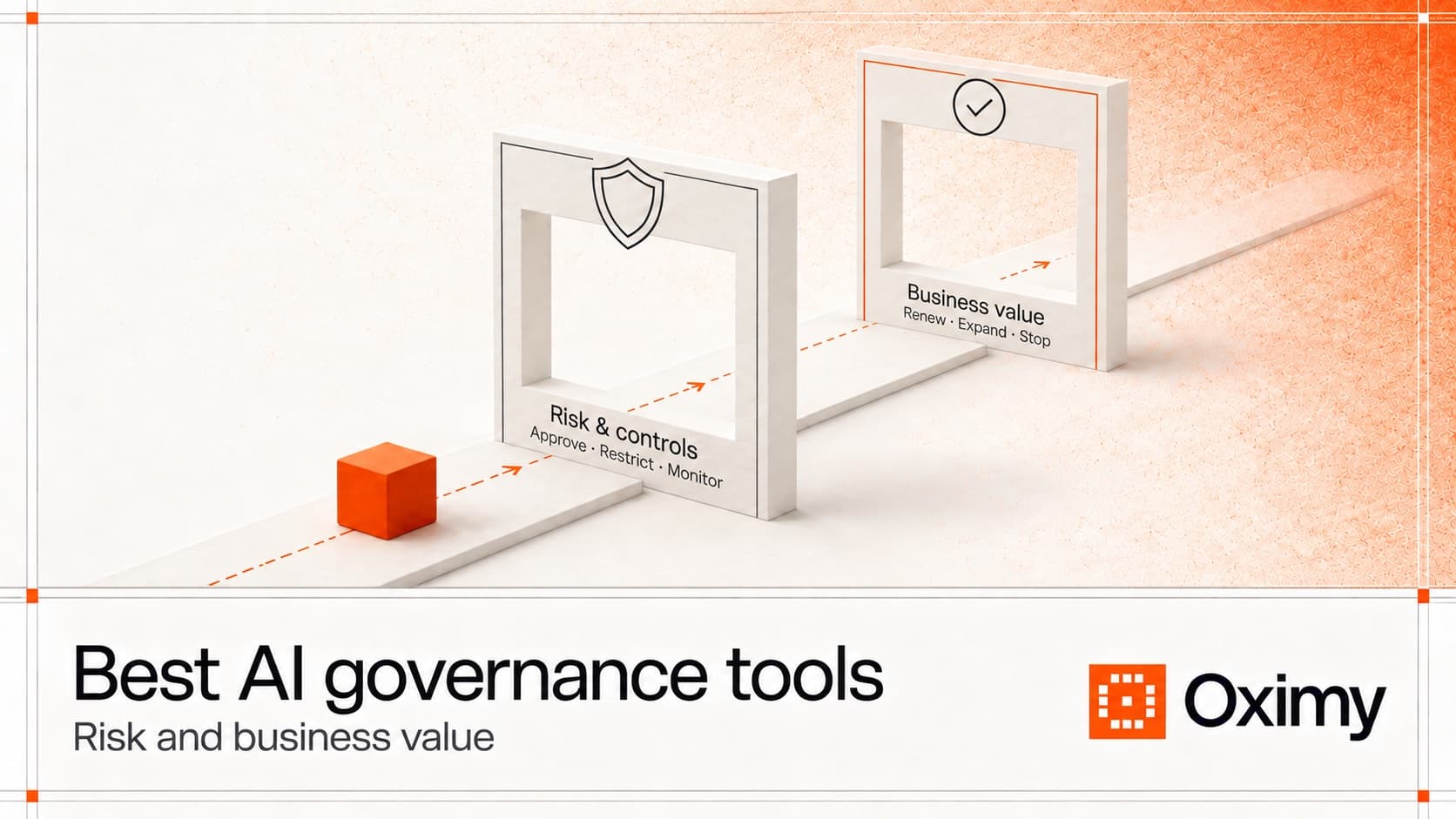 Best AI Governance Tools for Measuring Risk and Business Value
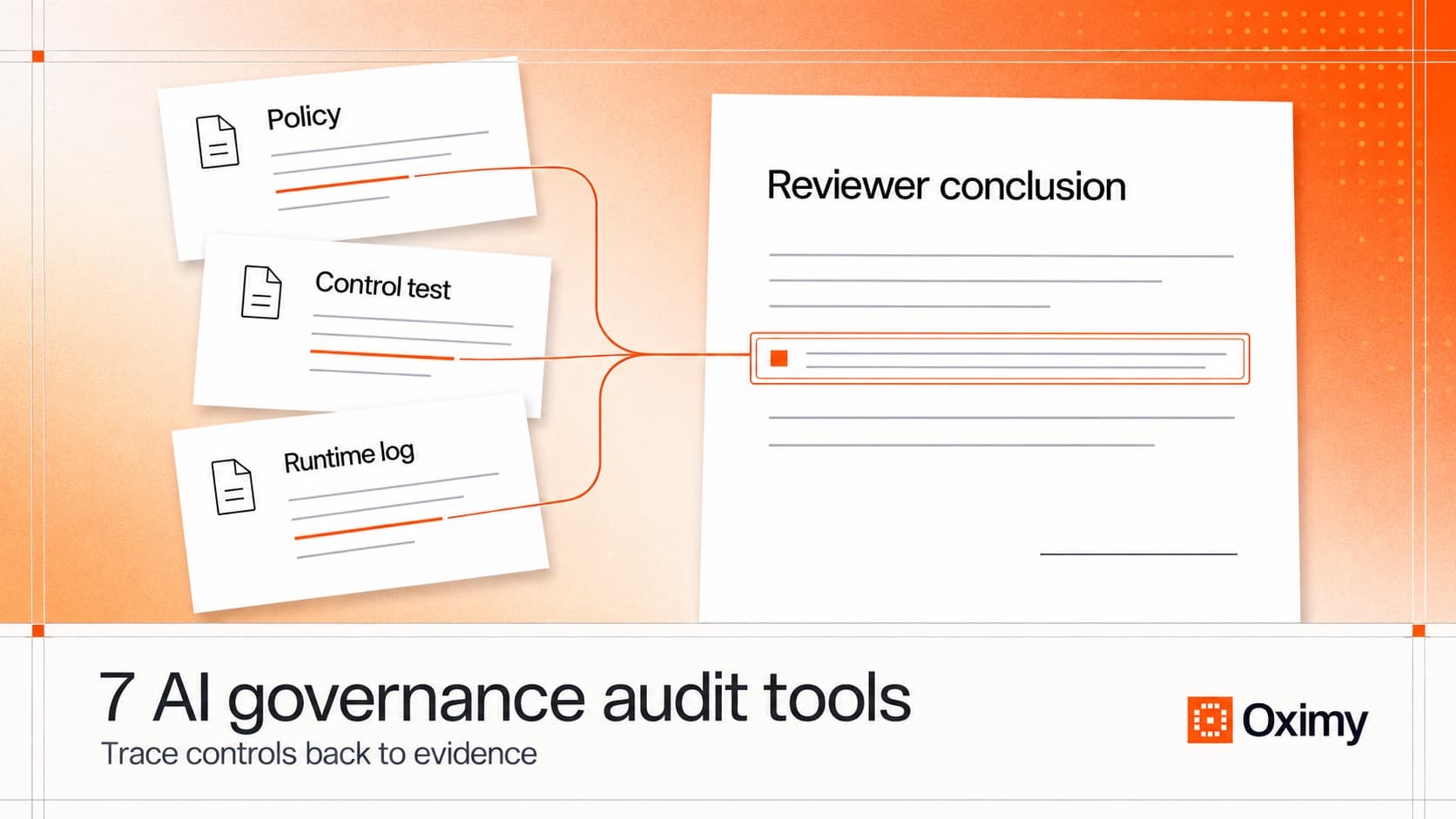 7 Best AI Governance Audit Tools for Large Enterprises in 2026
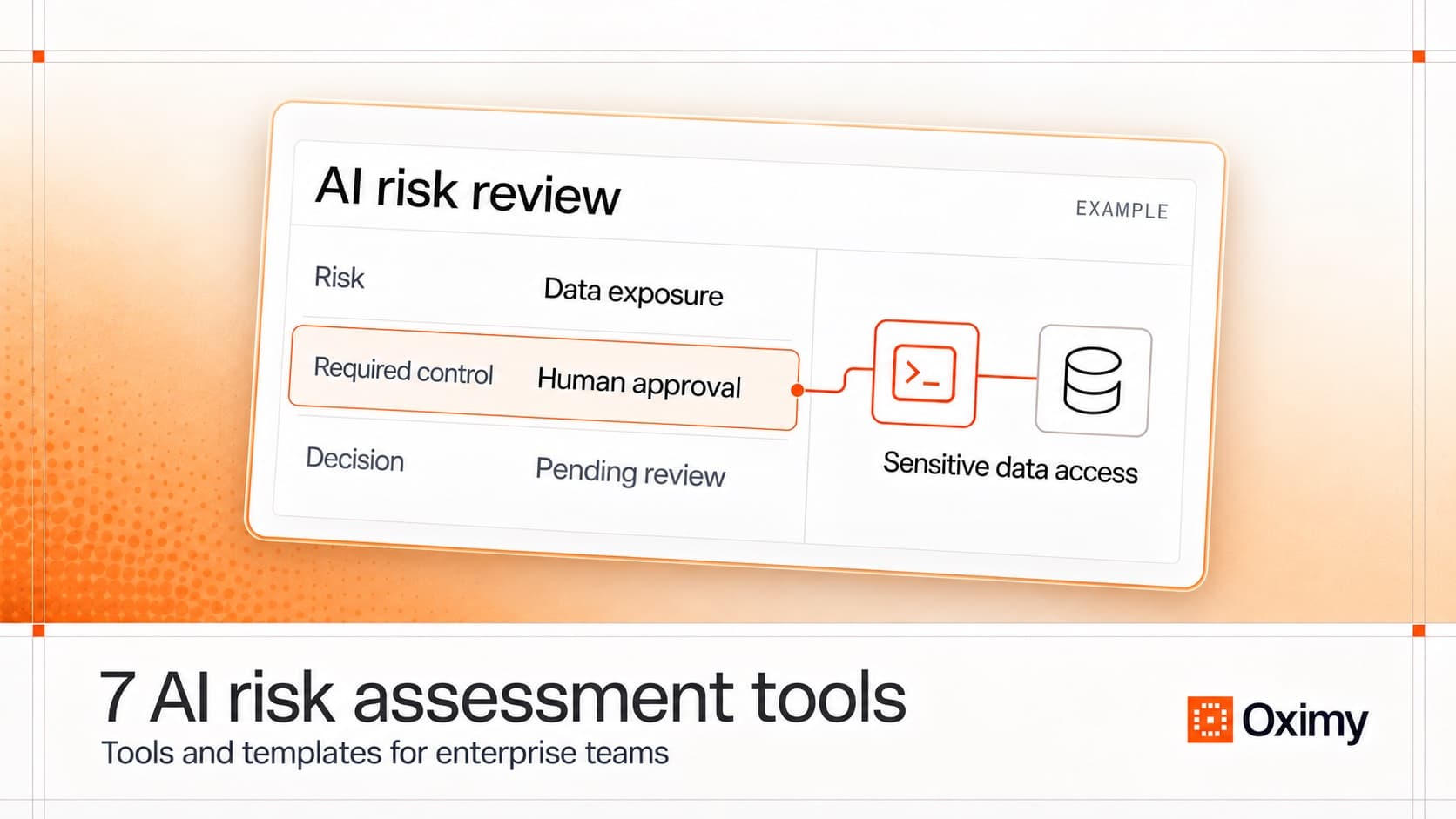 7 Best AI Risk Assessment Tools and Templates for Enterprise Teams in 2026