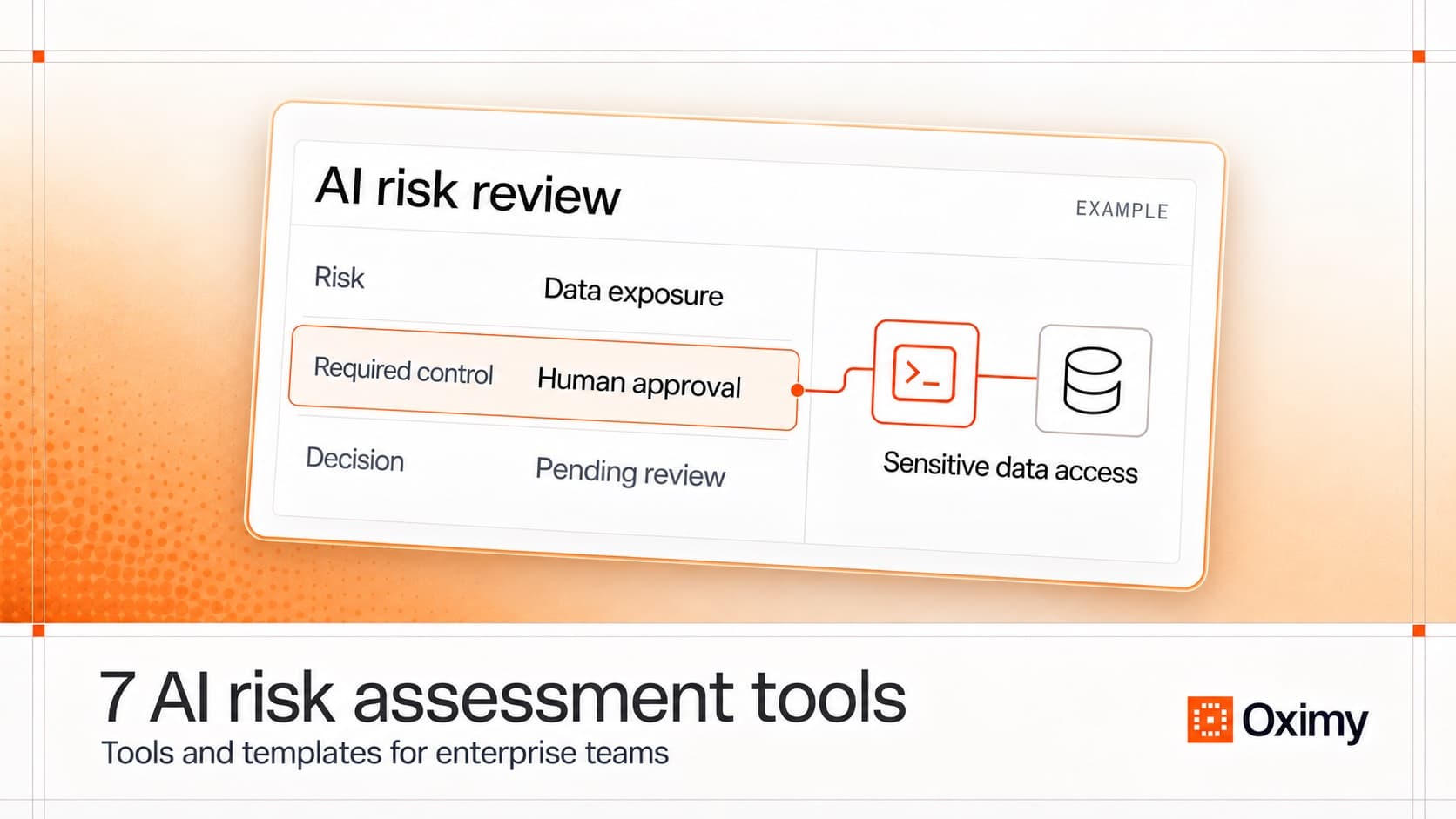
TL;DR
AI risk assessment tools help an enterprise identify an AI system or agent, understand its intended use and affected parties, evaluate credible failure modes, select controls, assign residual risk, and decide whether deployment should proceed.
The seven options in this guide support different parts of that process:
- Oximy is a local policy-control option for risks involving supported AI apps, data and coding-agent actions.
- Credo AI provides AI registry, contextual risk intelligence, policy mapping, governance workflows, and agent-focused risk and controls.
- IBM watsonx.governance supports use-case onboarding, risk identification and assessment, evaluations, monitoring, and compliance workflows.
- Holistic AI combines structured assessments with automated testing, risk mapping, red teaming, monitoring, and framework evidence.
- ServiceNow AI Control Tower connects AI risk and compliance assessments to asset lifecycle, business services, CMDB context, cases, and remediation.
- ModelOp Center codifies use-case risk assessments, generates risk tiers and initial controls, and carries decisions through lifecycle workflows.
- NIST AI RMF Playbook is a free, voluntary implementation resource for tailoring risk-management actions. It is not commercial assessment software or a universal checklist.
Published by Oximy. The comparisons reflect documented use-case fit, not hands-on product testing.
What is an AI risk assessment?
An AI risk assessment is a documented evaluation of how an AI system or agent could affect people, operations, security, compliance, finances, and business objectives in a defined context of use. It should lead to a decision, required controls, an accountable owner, and a review trigger.
An artificial intelligence risk assessment should follow a documented AI risk assessment framework: consistent criteria, named reviewers and traceable evidence. AI risk management tools can carry the decisions into ongoing monitoring and remediation; they do not remove the need for contextual judgment.
The assessment unit must be specific. “Generative AI” is too broad. A useful record names the application or agent, version, workflow, users, affected parties, data, tools, permissions, decisions, deployment environment, and owner.
The NIST AI RMF Core organizes risk work around Govern, Map, Measure, and Manage. NIST states that the functions are iterative rather than a fixed sequence. Its AI RMF Playbook provides voluntary suggested actions and explicitly says it is not a checklist that every organization must follow in full.
How the tools were compared
The comparison uses official product documentation to distinguish contextual assessment, technical testing, lifecycle decisions and implemented controls. It does not report hands-on testing, comparable pricing or independently verified customer results. Product fit depends on the deployment, integrations and evidence required; a broad feature claim is not proof of coverage in your environment.
AI risk assessment tools compared
| Tool or resource | Best fit | Publicly documented assessment strength | Important boundary |
|---|---|---|---|
| Oximy | Testing device-level controls against assessed risks | Local checks on supported AI requests and agent actions | Not a formal risk-scoring, legal-assessment or model-testing system |
| Credo AI | Contextual governance and policy-based AI risk | Registry, risk classification, regulatory intelligence, policy, control libraries, workflows, evidence | Buyers must verify discovery, test inputs, runtime coverage, and integrations |
| IBM watsonx.governance | Model, use-case, agent, risk, and compliance workflows | Onboarding, assessment, risk scoring, controls, evaluations, monitoring, regulatory records | Capabilities and dependencies vary by deployment and plan |
| Holistic AI | Structured assessment plus technical testing | Risk mapping, questionnaires, testing, red teaming, framework assessment, monitoring, remediation | Automated scores still require context, threshold governance, and human review |
| ServiceNow AI Control Tower | Assessment tied to assets, services, workflows, and cases | AI and risk assessments, regulatory classification, control effectiveness, risk posture, remediation | Requires verification of modules, plugins, data sources, and calculation rules |
| ModelOp Center | Policy-driven lifecycle risk assessment | Use-case intake, codified assessments, generated tiers, initial controls, approvals, monitoring | Buyers must inspect scoring logic, source evidence, and review independence |
| NIST AI RMF Playbook | Free framework and template foundation | Suggested actions across Govern, Map, Measure, and Manage, downloadable in several formats | Voluntary guidance, not certification, software, or a one-size-fits-all checklist |
Risk scores are summaries, not facts. Buyers should be able to inspect the factors, evidence, assumptions, weighting, uncertainty, reviewer, and approval behind any score.
1. Oximy: best for testing local controls against assessed AI risks
Oximy applies policies to supported AI requests and agent actions on the device. Evaluate it when the assessment identifies a data-sharing, coding-agent or business-action risk in that environment.
Translate the risk into a control test:
- Name the sensitive data or prohibited action.
- Identify the app, agent and device in scope.
- Set the permitted behavior and required approval.
- Test an allowed case and a prohibited case.
- Record the result, unsupported paths and residual risk.
These are evaluation steps, not a claim that Oximy generates the formal assessment or its risk score. Use the security review to confirm data boundaries, evidence access, retention and source permissions.
The assessment owner still decides whether the remaining risk is acceptable. Usage, cost and workflow results can inform whether to continue funding an approved system, but they do not lower a security or privacy risk merely because the system is productive.
2. Credo AI: best for contextual risk, policy and control mapping
Credo AI publicly describes AI and agent registries, risk classification, regulatory intelligence, policy packs, risk and control libraries, approval workflows, monitoring connections, and evidence recording.
Credo AI fits organizations that need one governance process across agents, applications, models, and vendors. Its contextual approach is relevant when risk depends on intended use, business setting, affected parties, autonomy, data, and regulatory obligations rather than model type alone.
Verify assessment methodology, configurable factors, policy inheritance, evidence requirements, exception handling, integration coverage, change triggers, and how technical test results enter the risk record.
3. IBM watsonx.governance: best for use-case, model and compliance assessment
IBM watsonx.governance publicly supports AI inventory, use-case onboarding, risk assessment, regulatory compliance, model and generative-AI evaluation, monitoring, and governance workflows. Confirm the risk and compliance capabilities included in the proposed deployment rather than assuming the same features across plans.
IBM fits enterprises that need risk records connected to model facts, evaluations, monitoring, use cases, and formal GRC workflows. It is especially relevant when model risk and compliance teams already use IBM governance products.
Verify deployment-specific features, supported models and agents, OpenPages dependencies, risk-scoring configuration, evaluation methods, third-party coverage, and evidence export.
4. Holistic AI: best for assessment combined with automated testing
Holistic AI publicly describes qualitative assessments, risk mapping, automated testing, bias and robustness evaluation, agentic red teaming, framework assessments, monitoring, compliance workflows, and remediation tracking.
Holistic AI fits when an enterprise wants assessment questions and technical tests in one risk process. That can help reviewers connect declared use and controls to observed model or agent behavior.
Verify test applicability, data and sample design, thresholds, error handling, reproducibility, model and agent coverage, risk-weighting rules, reviewer override, and how frequently assessments rerun after material change.
5. ServiceNow AI Control Tower: best for risk tied to enterprise assets and workflows
ServiceNow AI Control Tower publicly describes AI discovery, lifecycle management, risk, compliance, security, observability, and business context. ServiceNow's governance-record documentation describes assessments, inherent risk, control effectiveness, aggregated ratings, attestations, issues and exceptions.
ServiceNow fits organizations that want risk assessment connected to business applications, services, configuration items, owners, workflows, and remediation cases already managed on the platform.
Verify required modules and plugins, intake ownership, third-party discovery, assessment logic, control sources, separation of duties, exception workflow, and how changes to the AI asset trigger reassessment.
6. ModelOp Center: best for codified lifecycle risk assessment
ModelOp Center publicly describes standardized use-case intake, policy-based risk assessments, generated risk tiers, initial controls, approvals, testing, evidence collection, monitoring, recurring reviews, and attestations.
ModelOp fits enterprises that need the assessment to initiate and control a lifecycle workflow across internal, third-party, traditional, generative, and agentic AI.
Verify the factor model, evidence inputs, generated-control logic, policy-change handling, connector coverage, technical test ownership, reviewer override, and the audit trail for changes to ratings or approvals.
7. NIST AI RMF Playbook: best free foundation for an assessment template
The NIST AI RMF Playbook provides suggested actions aligned to Govern, Map, Measure, and Manage. It can be downloaded in PDF, CSV, Excel, and JSON formats and filtered by actors and topics.
The Playbook is useful for designing an internal AI risk assessment template because it covers context, affected parties, documentation, testing, monitoring, risk response, third parties, and continual improvement. NIST explicitly states that organizations should tailor the suggestions and that the Playbook is not an ordered checklist.
Use it as a source for assessment design, not as proof that a system is safe, compliant, certified, or low risk.
For agent-specific permissions, tool access and containment, use the AI agent governance tools comparison alongside the assessment. Select the builder or runtime separately with the enterprise AI agent platforms guide; choosing a platform does not complete the assessment.
Enterprise AI risk assessment template
Use this worksheet for one defined AI system or agent. Add legal, regulatory, sector, privacy, security, and model-risk fields required by the organization.
| Assessment field | Required entry | Evidence source |
|---|---|---|
| System identity | Name, stable ID, version, environment, vendor or builder | Inventory, architecture, procurement |
| Intended use | Workflow, purpose, users, affected parties, decisions, prohibited uses | Owner statement, process map, policy |
| Ownership | Business, technical, data, security, privacy, risk, legal, finance owners | Role assignment, approval record |
| Data | Inputs, outputs, sensitivity, provenance, retention, residency, access | Data catalog, privacy assessment, security records |
| Agent authority | Identities, permissions, tools, APIs, MCP servers, memory, action limits | IAM, architecture, runtime configuration |
| Failure modes | Safety, bias, privacy, security, reliability, legal, operational, financial harms | Threat model, impact assessment, incident history |
| Inherent risk | Likelihood, severity, scale, reversibility, exposure, uncertainty | Defined rating criteria and reviewer rationale |
| Controls | Preventive, detective, corrective, human oversight, fallback, kill path | Policies, test results, configuration, runbooks |
| Residual risk | Remaining likelihood, impact, uncertainty, acceptance authority | Control test evidence and signed decision |
| Monitoring | Metrics, thresholds, logs, drift, incidents, complaints, review cadence | Monitoring plans and systems of record |
| Value and trade-offs | Expected benefit, cost, adoption condition, outcome, quality guardrail | Business case, finance, workflow records |
| Decision | Approve, approve with conditions, pilot, restrict, remediate, reject, retire | Decision record, owner, due date |
| Reassessment triggers | Model, prompt, data, tool, permission, workflow, vendor, law, incident changes | Change management and monitoring |
Do not reduce this worksheet to one opaque score. The decision should show the significant risks, evidence quality, unresolved uncertainty, required controls, accountable owner, and review trigger.
How should companies assess AI risk before deployment?
Use a staged process:
- Define the system and context. Name the workflow, users, affected parties, data, decisions, autonomy, and boundaries.
- Assign owners. Separate business ownership from technical, security, privacy, legal, risk, and approval responsibilities.
- Identify credible harms and failure modes. Include misuse, unauthorized access, tool abuse, incorrect actions, bias, privacy loss, security compromise, operational failure, and financial exposure.
- Rate inherent risk using published internal criteria. Preserve uncertainty rather than manufacturing precision.
- Select and test controls. Record who owns each control, how it was tested, the result, and any exception.
- Decide residual risk. Name the acceptance authority and conditions for deployment.
- Define monitoring and reassessment triggers. Material changes and incidents should reopen the decision.
- Connect risk to value and portfolio action. A controlled system can still be unused or uneconomic, while a productive system can still carry unacceptable risk. The AI maturity model guide helps teams judge whether that review process works repeatedly.
Once the controls are operating, the AI governance audit tools guide explains how to retain test results, exceptions and approvals for independent review. A risk assessment records the deployment decision; an audit tests the evidence behind it.
Book an Oximy policy demo using one data-sharing rule and one agent-action boundary from your own environment.
Questions
Keep reading
 7 Best AI Governance Frameworks for Large Enterprises in 2026
 7 Best AI Governance Audit Tools for Large Enterprises in 2026
 7 Best AI Agent Governance Tools for Large Enterprises in 2026
 Best AI Governance Tools for Measuring Risk and Business Value
 7 Best AI Security Tools for Large Enterprises in 2026: Shadow AI, Agent Security and Runtime Protection Compared
Sources
- 01NIST AI RMF CoreNISTIndependent
- 02AI RMF PlaybookNISTIndependent
- 03Credo AICredo AIVendor-published
- 04IBM watsonx.governanceIBMVendor-published
- 05Holistic AIHolistic AIIndependent
- 06ServiceNow AI Control TowerServiceNowVendor-published
- 07governance-record documentationServiceNowVendor-published
- 08ModelOp CenterModelOpIndependent