TL;DR
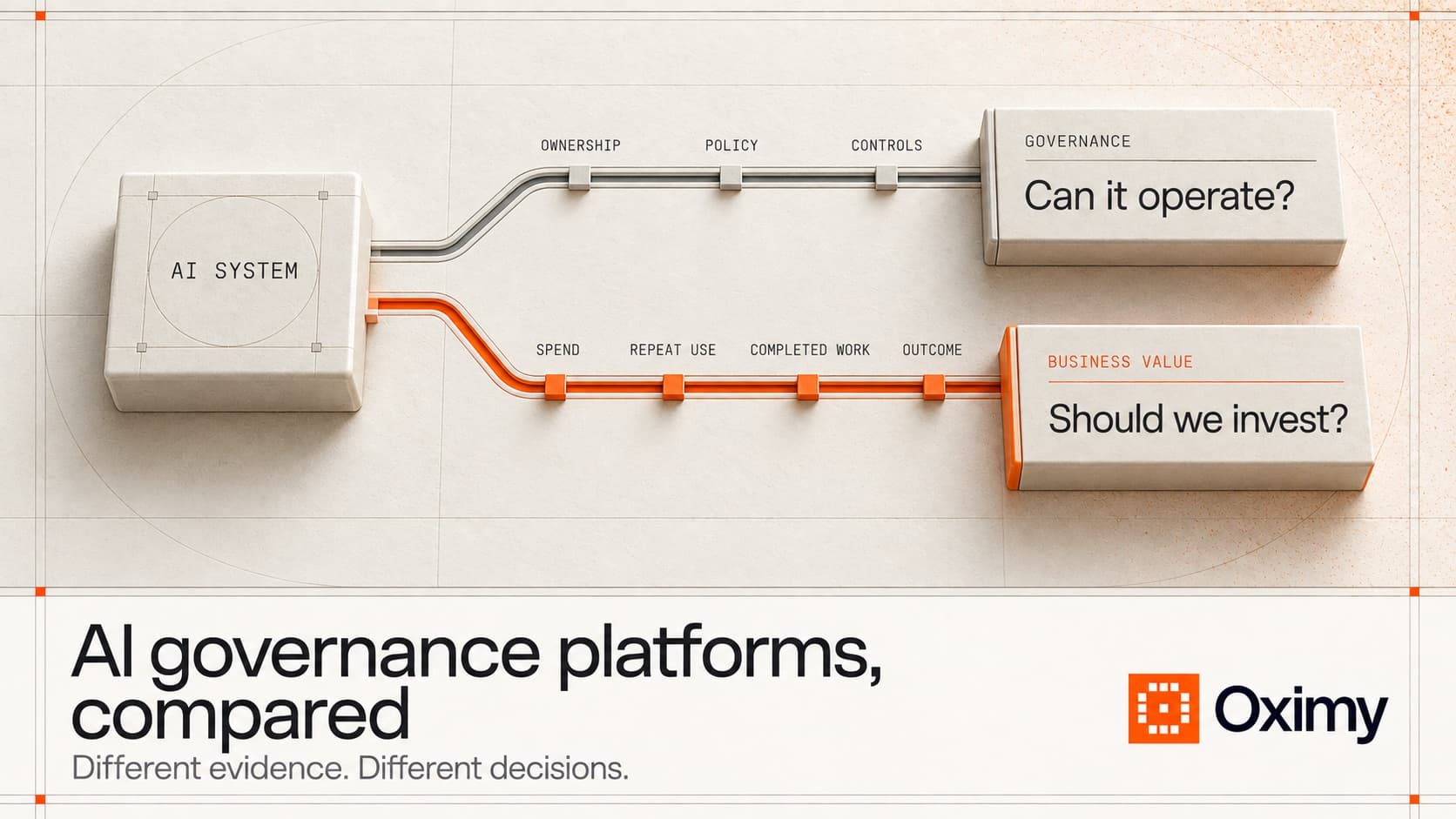
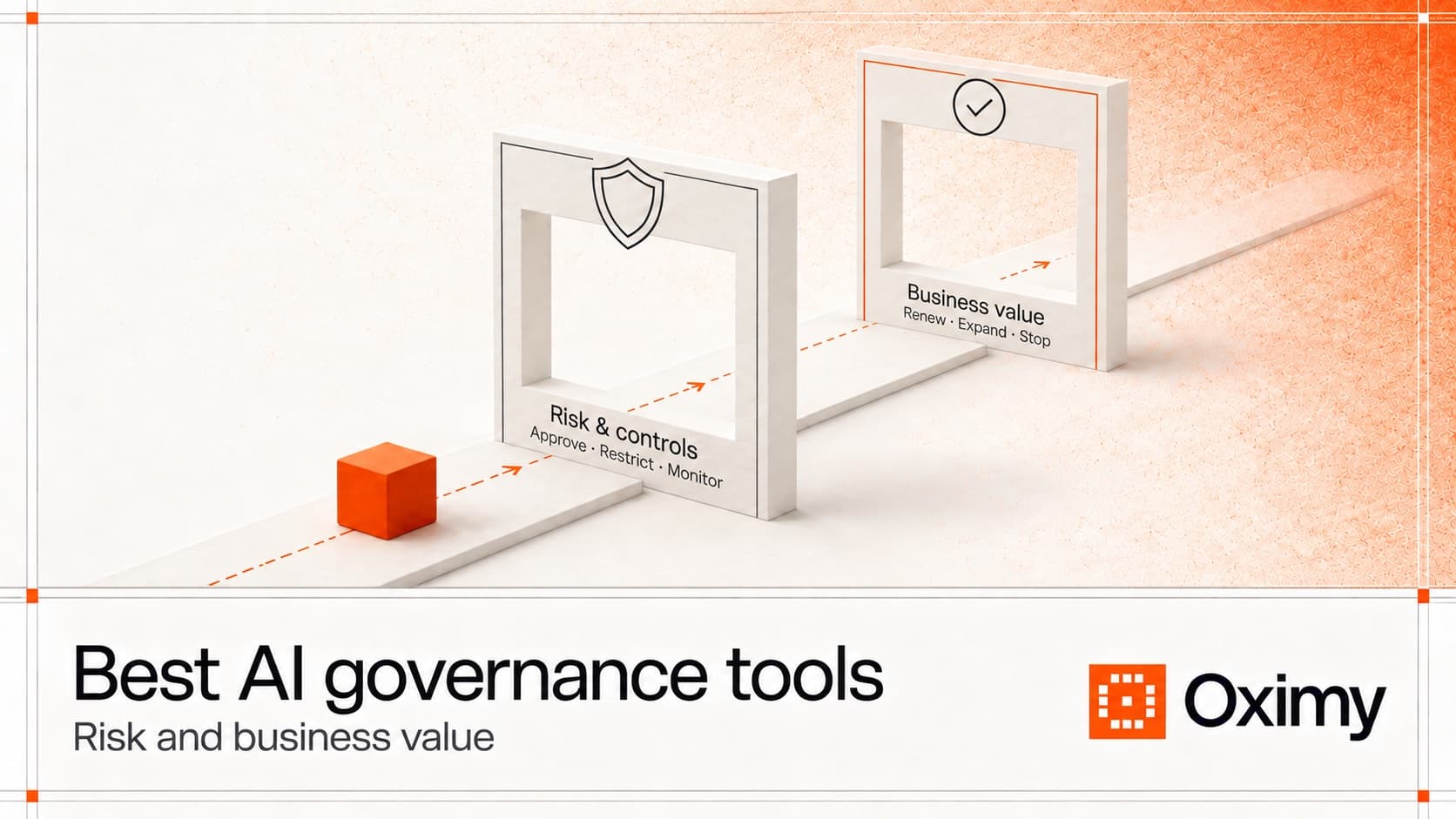
The best AI governance tools help an enterprise discover which AI systems exist, assign accountable owners, record intended use, apply proportionate policy and risk decisions, and preserve evidence for review. Security controls protect the data, identities, applications, and actions around those systems. Measurement then shows whether sanctioned AI is adopted and producing enough value to justify continued investment.
Governance comes first. A model, agent, application, or vendor needs an owner, approved purpose, risk treatment, and review record before its ROI claim is useful. Measurement is the evidence layer that connects the governed asset to cost, repeat adoption, completed work, outcomes, and confidence limits.
For most enterprise buyers, the practical shortlist has three layers:
- A governance operating layer for AI inventory, ownership, intended use, policy, approvals, exceptions, and review evidence.
- Security and compliance controls for discovery, data protection, identity, runtime activity, and enforcement in the systems already in use.
- A layer such as Oximy that enforces AI policy on employees' Windows and Mac devices and connects governed AI to adoption, spend, completed work, outcomes, and the next portfolio decision.
Credo AI, IBM watsonx.governance, Microsoft Purview, ServiceNow AI Control Tower, and Oximy all belong in the conversation, but they do not solve the same problem. The buying committee should compare them by decision evidence, not by category labels alone.
What AI governance tools should actually govern
AI governance software should turn AI policy into a repeatable operating process. The basic buyer question is not "do we have a policy?" It is "can we see, review, monitor, and defend the AI decisions the company is making?"
NIST's AI Risk Management Framework organizes AI risk work around Govern, Map, Measure, and Manage. ISO/IEC 42001 defines requirements for an AI management system. Those frameworks do not require one specific vendor, but they make the software job clearer.
At minimum, AI governance solutions should help teams answer:
| Governance question | What the tool needs to show | Why it matters |
|---|---|---|
| What AI exists? | Inventory of models, agents, applications, vendors, copilots, and shadow AI findings | You cannot govern systems nobody has recorded. |
| Who owns it? | Business owner, technical owner, risk owner, review status, next review date | AI accountability fails when every asset is orphaned. |
| What is it used for? | Intended use, affected users, workflow, data touched, decision impact | Risk depends on context, not just model type. |
| What controls apply? | Policies, assessments, exceptions, approvals, tests, monitoring requirements | Governance needs an inspectable record, not a slide. |
| What changed after deployment? | Incidents, drift, usage, unresolved issues, review outcomes | Approval at launch is not enough for ongoing AI systems. |
| What business decision follows? | Renew, expand, repair, restrict, consolidate, or stop | Governance should inform management action. |
The last row is where many governance programs thin out. A company may know that an AI system exists and passed review, but still not know whether it is worth the cost, whether adoption reached real work, or whether outcomes changed.
That gap is why the best ai governance tools for enterprise buyers now need to sit next to value measurement, spend visibility, adoption analysis, and workflow impact evidence.
AI governance platform versus AI governance software
The phrases overlap in search results, but buyers should keep a useful distinction.
An AI governance platform usually implies a system of record for AI assets, policies, workflows, approvals, monitoring, and reporting. It often supports multiple teams: AI program owners, legal, security, privacy, data, model risk, procurement, and business owners.
AI governance software can mean the full platform, but it can also refer to a narrower tool for assessments, policy workflow, model monitoring, red-team records, compliance evidence, or AI inventory.
Do not buy based on the noun. Buy based on the work:
- Can the team inventory AI systems and vendors?
- Can business owners describe intended use and workflow context?
- Can reviewers apply policy consistently?
- Can the platform preserve approval evidence?
- Can it monitor deployed systems?
- Can executives see which assets need attention?
- Can finance or the AI portfolio owner connect governed assets to cost and outcome evidence?
If the answer to the last question is no, the governance platform may still be good. It just should not be treated as a full AI ROI system.
How to govern AI tools and agents without slowing teams down
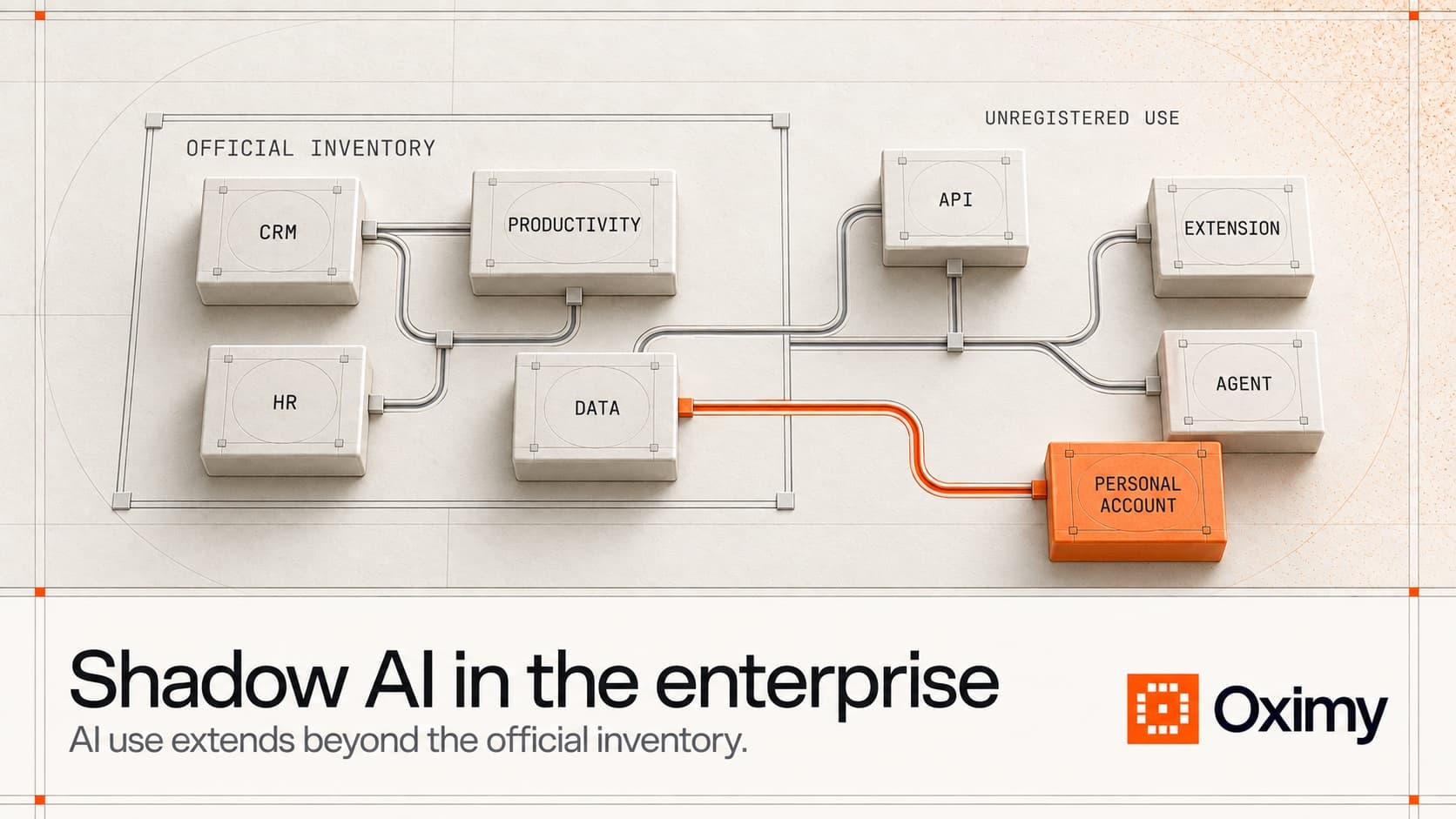
Start with one shared inventory of AI tools, models, applications, copilots, and agents. For each item, record the owner, intended workflow, data touched, risk tier, approval state, review date, and evidence required for continued use. Discovery tools can help find unmanaged or shadow AI, but each finding still needs to enter the same ownership and review process.
Use proportionate controls. A low-risk productivity assistant should not follow the same review path as an agent that changes customer records or influences a regulated decision. Set minimum controls by risk tier, make exceptions explicit, and give every review a deadline and a clear next action. That structure lets teams keep useful AI moving while security, legal, and business owners can see where stronger controls are justified.
Governance also needs an operating signal after approval. The AI dashboard software guide shows how inventory and control records can sit beside usage, spend, and outcome evidence. The AI ROI measurement tools guide covers the separate question of whether governed AI is producing enough value to renew or expand.
Quick comparison of AI governance tools
| Tool | Strongest public focus | Best fit | Value-measurement question to verify |
|---|---|---|---|
| Oximy | AI policy enforcement on Windows and Mac devices, plus adoption, spend, workflow impact, and portfolio review | Teams that need decision evidence across AI tools and workflows | Which governance platform remains the source of truth for policy, risk, and controls? |
| Credo AI | AI registry, risk intelligence, policy engine, governance workflows | Organizations building a dedicated AI governance program | Can governed AI assets be joined to cost, repeat adoption, completed work, and outcomes? |
| IBM watsonx.governance | AI use-case and model governance, monitoring, factsheets, risk, and compliance | IBM-centered or multi-model environments that need model and use-case controls | Which business outcomes are observed, and which are entered as assumptions, targets, or manual claims? |
| Microsoft Purview | Data security and compliance for Copilots, agents, enterprise AI apps, and detected third-party AI activity | Microsoft-heavy enterprises focused on data protection, audit, compliance, DLP, retention, and eDiscovery | How will security and usage signals connect to workflow performance or investment decisions? |
| ServiceNow AI Control Tower | AI discovery, governance, observability, security, and value calculation connected to ServiceNow context | Organizations already operating through ServiceNow workflows, services, and CMDB | What source records and attribution rules support the value calculation? |
These tools cover different layers of the governance stack. Oximy enforces AI policy on Windows and Mac devices and connects governance decisions to adoption, spend, workflow impact, and portfolio action, while specialist platforms may own broader risk, model, or compliance controls. The right stack depends on the organization's control environment, AI estate, source systems, risk model, and current decision.
1. Oximy: best for governance linked to operational and business evidence
Oximy's AI investment review page frames the problem around commitments, owners, repeat use, completed work, measured results, and the next action: renew, improve, consolidate, or stop. Its AI adoption page distinguishes assigned access, observed activity, repeat workflow use, and completed work. Its workflow impact page focuses on comparing similar completed work while keeping category, time window, quality measures, and cost definitions visible.
Oximy is positioned for AI governance and security in large-scale enterprises, with measurement as the evidence layer. It connects inventory and ownership to sanctioned use, spend, repeat adoption, completed work, outcomes, and portfolio action. On Windows and Mac devices it enforces AI policy: it checks AI requests, files, and coding-agent actions, then allows, warns, redacts, asks for review, or blocks according to the company's policy. It does not replace model evaluation workflows or compliance records.
Where Oximy fits:
- Connecting AI commitments to owners and decision dates.
- Separating assigned access from real adoption.
- Joining AI usage to completed-work evidence.
- Comparing workflow impact against baseline.
- Supporting investment review across tools, agents, and teams.
- Enforcing AI policy on Windows and Mac devices before a request, file, or agent action goes through.
What to verify:
- Which source systems Oximy can use in your environment.
- Which workflow records count as completed work.
- How cost, usage, work, and outcomes are joined.
- Which governance system remains the source of truth for approvals and risk controls.
- What security, deployment, and procurement material Oximy can provide under the approved sales process.
Oximy is strongest when governance leaders need one operating record from AI inventory and ownership through adoption, spend, workflow impact, and the next management decision.
2. Credo AI: best for a dedicated AI governance program
Credo AI publicly describes a platform for AI governance across agents, applications, models, and vendors. Its site describes an AI Registry, risk intelligence, policy engine, governance workflows, and integrations with systems such as Snowflake, Databricks, AWS, Azure, ServiceNow, Jira, GitHub, and MLflow.
Credo AI belongs on the shortlist when the company needs a dedicated AI governance layer rather than scattered spreadsheets, ticket queues, and policy documents. The buyer problem is usually visibility and control: which AI systems exist, whether they follow policy, how exceptions are handled, and what evidence is available for reviewers.
Where Credo AI appears strongest from public materials:
- AI registry and inventory.
- Policy and risk workflow.
- Governance evidence across different AI assets.
- Agent, model, application, and vendor governance positioning.
- Regulatory and risk-intelligence language for governance teams.
What to verify before buying:
- Which AI assets the platform can discover automatically versus which must be entered manually.
- How ownership, workflow context, and intended use are captured.
- Which integrations are included in the purchased deployment.
- How policy exceptions and ongoing monitoring are represented.
- Whether cost, repeat adoption, completed work, and outcome evidence can be joined or exported for a separate value review.
Credo AI is a governance-first option. If the buying committee is also trying to prove ROI, the evaluation should include a second proof exercise: pick one governed AI use case and trace it to investment, usage, completed work, and outcome evidence.
3. IBM watsonx.governance: best for model and use-case governance
IBM watsonx.governance focuses on governing AI across models and use cases. IBM describes capabilities around inventories, factsheets, model evaluation, monitoring, risk, and compliance, including governance for third-party models in specified environments.
IBM watsonx.governance is most relevant when the enterprise already uses IBM data, AI, or governance products, or when the AI governance operating model needs strong model and lifecycle controls. It can be a fit for teams that need to document model behavior, support responsible AI processes, and prepare compliance evidence.
Where it appears strongest from public materials:
- AI use-case and model inventories.
- Factsheets and lifecycle documentation.
- Model evaluation and monitoring.
- Risk and compliance workflows.
- Support for governance across IBM and selected third-party model contexts.
What to verify:
- Which capabilities apply to the exact deployment option being considered.
- Which model types, clouds, tools, and repositories are supported.
- What requires other IBM services or configuration.
- How model-level evidence connects to the business workflow using the model.
- Whether business-value claims are observed from operational systems or entered as assumptions.
For ROI, the risk is category confusion. Model governance can show that a model was assessed and monitored. It does not automatically show that an AI investment changed cycle time, quality, capacity, revenue, risk, or cost per completed unit.
4. Microsoft Purview: best for Microsoft data security and compliance
Microsoft Purview addresses data security and compliance for Microsoft Copilots, agents, enterprise AI apps, and detected third-party generative AI activity. Microsoft documents controls for data classification, data loss prevention, auditing, retention, eDiscovery, communication compliance, compliance management, and related AI protection scenarios.
Purview is a natural governance layer for Microsoft-heavy organizations. If the AI estate includes Microsoft 365 Copilot, agents in Microsoft environments, and sensitive data governed through Microsoft tools, Purview can help security, compliance, and legal teams understand and control data risk.
Where it appears strongest from public materials:
- Data protection and compliance for Microsoft AI use.
- Sensitive-data visibility and controls.
- Audit, retention, and eDiscovery context.
- DLP and compliance management.
- Detection of some third-party generative AI activity in supported scenarios.
What to verify:
- Which Copilot, agent, and third-party AI activities are visible in the organization's licensing and configuration.
- What data is logged and retained.
- Which policies can be enforced versus only reported.
- How alerts and review workflows connect to existing security operations.
- How Purview signals would feed a broader AI dashboard or value-measurement program.
Purview should not be mistaken for a complete AI value measurement platform. A prompt, policy event, audit record, or sensitive-data finding can support governance. It does not by itself show that a workflow improved.
5. ServiceNow AI Control Tower: best for ServiceNow-centered operations
ServiceNow AI Control Tower publicly positions itself around AI discovery, inventory, observability, governance, security, and value calculation. ServiceNow describes relating AI assets to business services through ServiceNow and its CMDB.
This is relevant when the organization already uses ServiceNow as an operating system for services, workflows, requests, incidents, assets, or governance. In that environment, AI oversight can benefit from the surrounding operational context.
Where it appears strongest from public materials:
- AI discovery and inventory.
- Governance and observability.
- Security and control context.
- Relationship to business services and CMDB.
- Value-calculation positioning inside a ServiceNow operating model.
What to verify:
- Which AI assets can be discovered automatically.
- Which records come from ServiceNow and which come from external systems.
- How value is calculated.
- Which operational workflow records are required for the calculation.
- Whether the result can be exported or reproduced for finance review.
The important buyer test is not whether a value field exists. It is whether the value evidence uses an accepted baseline, cost boundary, adoption definition, completed-work record, quality guardrail, and attribution rule.
When governance software is enough, and when it is not
AI governance software may be enough when the decision is mainly control:
- Build an AI inventory.
- Standardize intake and review.
- Apply risk policy.
- Track approvals and exceptions.
- Monitor deployed AI systems.
- Prepare compliance evidence.
It is not enough when the buying committee needs to decide investment:
- Should we renew this AI tool?
- Should this agent move from pilot to production?
- Which workflows deserve expansion?
- Which teams need enablement or redesign?
- Which costs should be consolidated?
- Which claimed benefits are unsupported?
Those questions require a broader evidence chain:
| Evidence layer | Governance-only view | Value-measurement view |
|---|---|---|
| Asset | Model, agent, vendor, application, or use case | Same asset tied to an investment or workflow |
| Owner | Accountable reviewer or business owner | Owner plus decision date and budget consequence |
| Use | Intended use and policy context | Repeat adoption inside a named workflow |
| Cost | Often contract, tool, or system record | Cost allocated to the workflow or investment boundary |
| Outcome | Risk, compliance, incidents, monitoring | Speed, quality, capacity, revenue, risk reduction, or unit cost |
| Decision | Approve, reject, restrict, monitor | Renew, expand, improve, consolidate, or stop |
Keep the distinction explicit: governance reduces uncontrolled AI risk, while value measurement helps leadership decide whether controlled AI is worth continued investment.
How to choose the best AI governance tools
Use one real AI system as the buying test. The system should be important enough to matter and messy enough to expose the truth.
- Name the governed entity. Decide whether the unit is a model, agent, application, vendor, workflow, or investment.
- Identify owners. Capture the business owner, technical owner, risk owner, and finance stakeholder.
- Map the source records. List where ownership, approvals, policies, tests, usage, cost, work, outcomes, and exceptions live.
- Run the intake and review workflow. Watch how evidence is captured, who approves, how exceptions are stored, and what remains manual.
- Test ongoing monitoring. Confirm whether the platform can detect changes after deployment and route review work to the right team.
- Add a value review. Ask how the governed system connects to repeat adoption, completed work, outcome movement, and a management action.
- Inspect exports and audit trails. A reviewer should be able to reconstruct the decision without the vendor narrating it.
- Confirm procurement details. Pricing, deployment, retention, integrations, support, and security details should come from the vendor directly.
Reject any tool evaluation that only shows a polished dashboard. A good demo should make missing evidence visible. If the platform cannot show unknowns, it will tempt the organization to overstate confidence.