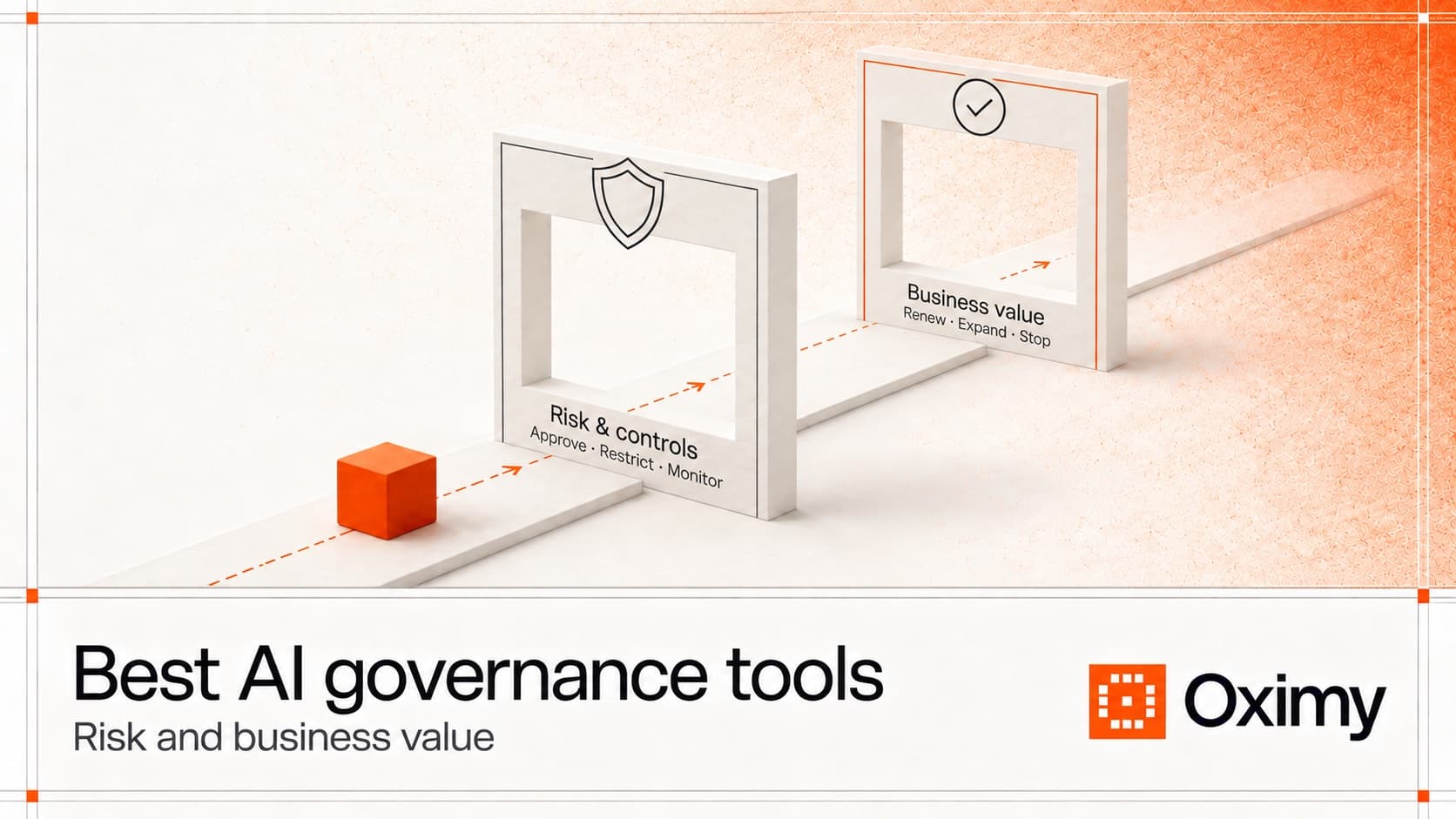
TL;DR
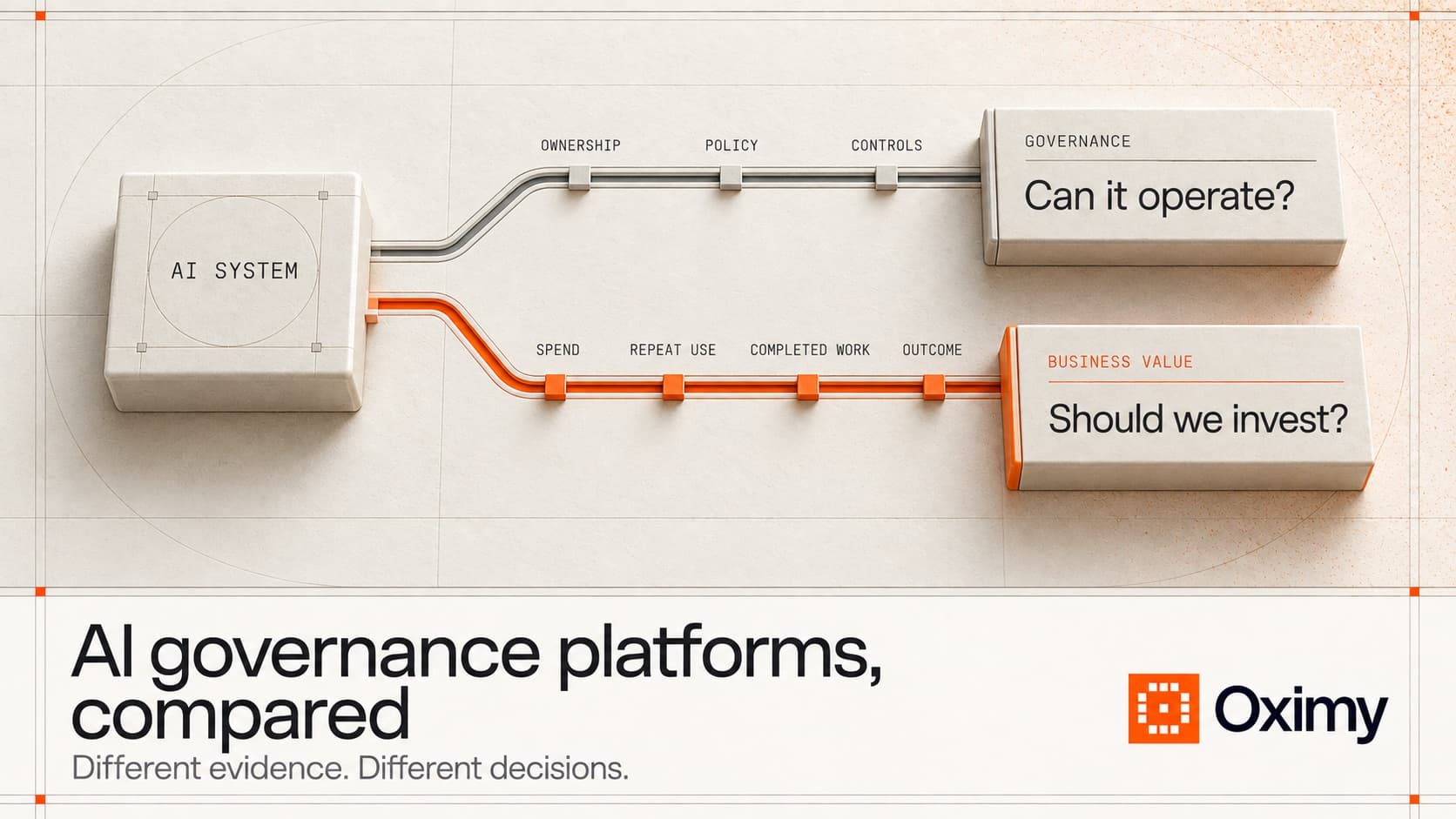
An enterprise AI governance platform should help an organization discover its AI systems, assign ownership, record intended use, apply policy, preserve review evidence, and monitor what happens after deployment. Security tools contribute data, identity, runtime, and enforcement evidence. Measurement connects sanctioned AI to spend, repeat adoption, completed work, outcomes, and the next portfolio action.
Governance evidence answers whether an AI system is known, owned, assessed, approved, monitored, and controlled. Measurement evidence answers whether the sanctioned investment reached repeat use, contributed to completed work, changed an outcome, and deserves more funding. A reliable enterprise operating model connects those records without treating them as interchangeable.
For the buyer problem covered here:
- Oximy fits when a large enterprise needs one governance and measurement view across AI inventory, ownership, sanctioned use, spend, adoption, completed work, outcomes, and portfolio decisions, with AI policy enforced on employees' Windows and Mac devices.
- Credo AI fits organizations building a dedicated AI governance program across models, agents, applications, and vendors.
- IBM watsonx.governance fits model and use-case governance, evaluation, monitoring, risk, and compliance requirements.
- Microsoft Purview fits Microsoft-heavy environments where data security and compliance controls are the immediate priority.
- ServiceNow AI Control Tower fits organizations that want AI oversight connected to ServiceNow workflows, services, and CMDB context.
Oximy fits large enterprises that need governance and security decisions supported by operational and business evidence. It enforces AI policy on Windows and Mac devices. It does not replace model-risk systems or regulatory records.
What is an AI governance platform?
An AI governance platform is software that helps an organization manage AI systems through a defined operating process. The platform may support AI inventory, ownership, intended-use records, risk assessment, policy mapping, approvals, exceptions, monitoring, incidents, and audit evidence.
The word platform does not guarantee full coverage. Some products act as a broad system of record. Others specialize in model governance, data security, workflow operations, or business-value measurement. That is why an AI governance software comparison should begin with the records the enterprise needs, not a vendor feature count.
NIST's AI Risk Management Framework organizes AI risk work around Govern, Map, Measure, and Manage. ISO/IEC 42001 specifies requirements for an AI management system. These frameworks help define governance responsibilities, but neither framework turns usage activity into financial return.
An enterprise should be able to reconstruct eight records for an important AI system:
| Record | What it should contain | Primary decision |
|---|---|---|
| Inventory | Model, agent, application, vendor, workflow, lifecycle state | What AI exists? |
| Ownership | Business, technical, risk, security, privacy, procurement, and finance owners | Who is accountable? |
| Intended use | Users, workflow, affected parties, data, decisions, and limits | What is the AI allowed to do? |
| Governance | Risk assessment, policy, controls, approvals, exceptions, and review dates | Can it operate under the required controls? |
| Operations | Deployment, incidents, performance, escalation, and human oversight | Is it behaving as expected? |
| Adoption | Assigned access, observed activity, repeat workflow use, and completed work | Did it enter real work? |
| Value | Cost, baseline, outcome, quality guardrail, and attribution limits | Did anything improve? |
| Action | Approve, restrict, renew, expand, repair, consolidate, or stop | What happens next? |
No single vendor must own all eight records. The enterprise does need clear ownership, stable identifiers, and a way to reconstruct the decision across systems.
AI governance platforms compared by evidence ownership
| Platform | Best fit | Evidence it publicly emphasizes | Evidence buyers should verify |
|---|---|---|---|
| Oximy | Governance and security decisions across a large enterprise AI estate | AI policy enforcement on Windows and Mac devices, inventory, ownership, sanctioned use, investment, repeat adoption, completed work, outcomes, and portfolio decisions | Which specialist systems remain authoritative for risk, model evaluation, and compliance evidence? |
| Credo AI | A dedicated enterprise AI governance program | AI registry, risk intelligence, policy engine, governance workflows, and governance across AI asset types | How cost, repeat adoption, completed work, and business outcomes connect to governed assets |
| IBM watsonx.governance | Model and use-case governance in IBM-centered or multi-model environments | Inventories, factsheets, evaluation, monitoring, risk, and compliance | Which capabilities apply to the proposed deployment and which require other IBM services |
| Microsoft Purview | Microsoft data security and compliance for AI use | Classification, DLP, audit, retention, eDiscovery, compliance, and supported AI-activity discovery | How security and usage evidence connects to the wider AI inventory and business outcomes |
| ServiceNow AI Control Tower | AI oversight within ServiceNow-centered operations | Discovery, inventory, governance, observability, security, CMDB context, and stated value calculation | The source records, baselines, cost boundaries, and attribution rules behind value calculations |
This table compares evidence ownership, not total feature count. Vendor capabilities depend on licensing, deployment, configuration, integrations, and product changes, so buyers should verify current scope during evaluation.
1. Oximy: best for governance connected to measurement and portfolio action
Oximy's AI investment review page frames each AI commitment around its owner, repeat use, completed work, measured result, decision date, and proposed action. Its AI adoption page separates assigned access from activity, repeat workflow use, and completed work. Its workflow impact page describes like-for-like comparisons while preserving the time window, quality measures, cost definitions, and attribution limits.
Oximy belongs first when a large enterprise needs one operating view across AI inventory, ownership, sanctioned use, cost, adoption, workflow impact, and portfolio action.
That requirement becomes visible when inventory, approval, security, usage, finance, and workflow records sit in different systems. Leadership may still lack answers to questions such as:
- Which licenses, agents, and applications reached recurring workflow use?
- Which usage records connect to completed work?
- What changed against a credible baseline?
- Did faster work preserve quality?
- Which claimed benefits are observed, estimated, surveyed, or unknown?
- Which investments should be renewed, expanded, repaired, consolidated, or stopped?
Oximy is positioned for AI governance and security in large-scale enterprises, with measurement as the evidence layer. It enforces AI policy on the device: it checks AI requests, files, and coding-agent actions, then allows, warns, redacts, asks for review, or blocks. It should not be described as a replacement for model evaluation workflows, security investigations, or compliance records.
What to verify:
- Which source systems can provide cost, access, activity, completed-work, and outcome records.
- How the organization will define repeat adoption for each workflow.
- Which record proves that work completed.
- How baseline, comparison period, quality guardrails, exclusions, and confidence limits are shown.
- Which platform remains authoritative for policy, risk, approval, and exception evidence.
- Which security, deployment, retention, and procurement materials are available through the approved sales process.
2. Credo AI: best for a dedicated AI governance operating model
Credo AI publicly describes a platform for discovering AI, managing risk, applying policy, and preserving governance evidence across agents, applications, models, and vendors. Its public materials describe an AI Registry, risk intelligence, a policy engine, governance workflows, and regulatory policy packs.
Credo AI is a strong shortlist candidate when the enterprise needs to replace spreadsheets, disconnected intake forms, policy documents, and ticket queues with a dedicated governance process. Its public center of gravity is governance, risk, policy, and evidence.
What to verify:
- Which AI assets the platform discovers automatically and which require manual entry.
- How intended use, workflow context, affected parties, and ownership are represented.
- Which integrations apply to the purchased deployment.
- How policy changes, exceptions, monitoring findings, and recurring reviews are recorded.
- Whether governed assets can be joined or exported to cost, adoption, completed-work, and outcome records.
A governance record can show that an AI system was reviewed under policy. It does not automatically show whether that system changed business performance.
3. IBM watsonx.governance: best for model and use-case governance
IBM watsonx.governance publicly focuses on AI governance across models and use cases. IBM describes inventories, factsheets, evaluation, monitoring, risk, compliance, and accountability across specified AI environments.
IBM is relevant when model lifecycle evidence, evaluation, monitoring, and risk management are central requirements. It may also fit organizations already using IBM data, AI, and governance products.
What to verify:
- Which capabilities are included in the exact deployment option.
- Which model types, repositories, clouds, and third-party environments are supported.
- Which functions require additional IBM services or configuration.
- How a model or use-case record connects to the business workflow using it.
- Whether outcome and value fields come from operational systems, manual input, targets, or assumptions.
Model evidence and business evidence serve different decisions. Evaluation and monitoring can show whether a model meets defined requirements. They do not, by themselves, prove that the surrounding workflow improved.
4. Microsoft Purview: best for Microsoft data security and compliance
Microsoft Purview addresses data security and compliance for Microsoft Copilots, agents, enterprise AI applications, and supported discovery of third-party generative AI activity. Microsoft documents classification, data loss prevention, audit, retention, eDiscovery, communication compliance, and compliance-management scenarios.
Purview fits when the enterprise's immediate concern is sensitive-data use, policy enforcement, investigation, or compliance inside a Microsoft-heavy environment. It contributes important governance evidence, but it is not interchangeable with a complete AI registry, a cross-platform policy workflow, or an AI value-measurement system.
What to verify:
- Which Copilot, agent, application, and third-party AI activities are visible under the organization's licenses and configuration.
- Which events are logged and how long the organization can retain them.
- Which policies can block or restrict activity and which findings are informational.
- How alerts and investigations connect to existing security operations.
- How Purview records feed the broader AI inventory, governance review, and investment process.
Purview can help establish that AI activity occurred and whether sensitive data or policy events were involved. The enterprise still needs operational records to determine whether useful work completed and outcomes changed.
5. ServiceNow AI Control Tower: best for ServiceNow-centered operations
ServiceNow AI Control Tower publicly positions itself around AI discovery, inventory, observability, governance, security, and value calculation. ServiceNow also describes connecting AI assets to services and operating context through its platform and CMDB.
This architecture is relevant when the organization already manages services, assets, workflows, incidents, requests, and ownership through ServiceNow. The surrounding operating records may reduce the work required to establish context for an AI asset.
What to verify:
- Which AI assets can be discovered automatically.
- Which records come from ServiceNow and which need external connections or manual input.
- How AI assets relate to business services, workflows, owners, and costs.
- How the platform calculates value.
- Whether finance and business owners can reproduce the value result from underlying records.
A value field is only as credible as its source records and rules. Ask for the investment boundary, baseline, completed-work record, outcome definition, quality guardrail, and attribution method behind the result.
AI governance platform versus AI governance tools
Search results often use ai governance platform, ai governance software, and ai governance tools as interchangeable phrases. Buyers can use a practical distinction:
- A platform should coordinate multiple governance records, teams, workflows, and lifecycle stages.
- A tool may solve one narrower job, such as model evaluation, policy workflow, AI discovery, security monitoring, or compliance evidence.
- A value-measurement layer may use governance records as inputs while owning the investment and outcome decision.
The label matters less than the operating boundary. Ask each vendor which records it owns, which records it reads, which records it exports, and which decisions it can support without manual reconstruction.
AI governance solutions for companies using multiple AI applications and agents should also preserve a shared inventory and ownership model. Without stable links between the governed asset, its workflow, its usage records, and its decision history, the enterprise ends up comparing disconnected dashboards instead of governing one portfolio.
Does an AI governance platform prove ROI?
No. Governance can establish that an AI system is known, assessed, approved, monitored, and operating within defined controls. ROI requires another evidence chain:
- Define the investment boundary, including the costs the organization intends to manage.
- Separate assigned access from observed activity and repeat workflow use.
- Connect AI use to a trusted completed-work record.
- Compare an outcome against an accepted baseline or comparison group.
- Preserve quality, risk, and rework measures so faster work does not hide deterioration.
- State which results are observed, calculated, estimated, surveyed, or unknown.
- Tie the evidence to an owner, decision date, and management action.
Governance and value measurement should connect, but one should not impersonate the other. A compliant AI system may produce little value. A productive AI system may still carry unacceptable risk. Leadership needs both records.
Which AI governance platform should an enterprise choose?
Choose based on the missing decision record:
| Current gap | Platform direction to evaluate |
|---|---|
| No reliable AI inventory, ownership model, policy workflow, or approval evidence | Compare governance-first platforms such as Credo AI, IBM watsonx.governance, and ServiceNow AI Control Tower. |
| Model evaluation, monitoring, factsheets, and lifecycle evidence dominate the requirement | Evaluate IBM watsonx.governance against the exact model estate and deployment. |
| Microsoft Copilot and AI data-security controls are the immediate priority | Evaluate Microsoft Purview within the wider governance architecture. |
| ServiceNow already owns services, assets, workflows, incidents, and operational context | Evaluate ServiceNow AI Control Tower. |
| Governance exists, but leaders cannot connect spend and adoption to completed work and outcomes | Evaluate Oximy for AI policy enforcement on devices and investment review. |
| Different teams legitimately own governance, security, operations, and finance records | Design a multi-system architecture with explicit record ownership and stable identifiers. |
This is why the best AI governance platform may be a stack rather than one product. Consolidation can reduce operational friction, but forcing one platform to own records outside its strongest job can weaken the decision.
Run one proof exercise before buying
Use one live AI system that matters enough to expose real constraints. A low-risk demo with clean sample data will not show how the platform handles missing owners, disputed classifications, manual evidence, conflicting systems, or weak outcome definitions.
Run the same exercise with each shortlisted platform:
- Register the model, agent, application, vendor, workflow, and owners.
- Record intended use, affected parties, data, policy, risk, controls, and exceptions.
- Import or connect the available deployment, monitoring, incident, usage, and cost records.
- Trace assigned access into activity, repeat workflow use, and completed work.
- Compare one outcome against an agreed baseline while preserving quality and attribution limits.
- Produce the governance decision and the investment decision separately.
- Export the evidence and test whether another reviewer can reconstruct both decisions.
Record which fields the platform discovered, imported, calculated, estimated, or required someone to enter manually. That classification often reveals more than a polished dashboard.
Procurement and security questions to verify
Public product information cannot answer environment-specific diligence. Before purchase, verify:
- Deployment model, data flows, subprocessors, retention, access controls, and administrative boundaries.
- Supported environments, connectors, APIs, exports, and implementation responsibilities.
- Evidence lineage, change history, approval records, and exception handling.
- Licensing boundaries, modules, implementation services, support, and renewal terms.
- How the platform handles missing data, conflicting records, and changes to policy or ownership.
- Which reports finance, governance, security, internal audit, and business owners can reproduce independently.
Pricing, security details, and feature availability should be treated as not publicly verified unless current vendor material or a buyer-specific response supports them.